

Marketing ROI measures the financial return generated by marketing compared with the amount invested. It helps businesses evaluate whether campaigns, channels, and broader marketing programs are contributing enough revenue or profit to justify their costs.
The basic formula is straightforward, but reliable marketing ROI measurement is not. Teams must decide which costs to include, how revenue should be attributed, when returns should be measured, and how to account for customer journeys involving several channels.
Marketing ROI is therefore more than a calculation. It is a measurement framework that connects marketing activity, attribution, revenue, and budget decisions.
What Is Marketing ROI?
Marketing ROI, or marketing return on investment, compares the value generated by marketing with the cost of producing that value.
It helps answer questions such as:
- Is marketing generating more value than it costs?
- Which campaigns or channels produce the strongest return?
- Are higher-spend activities creating enough additional revenue?
- Where should the next portion of the marketing budget be invested?
- Which programs need improvement before they can scale?
Marketing ROI may be calculated for one campaign, a channel, a customer segment, a product, or the entire marketing function. The scope should always be clear because comparing a campaign-level ROI with a company-wide marketing ROI can lead to misleading conclusions.
How to Calculate Marketing ROI
A common marketing ROI formula is:
Marketing ROI = (Revenue attributed to marketing − Marketing cost) ÷ Marketing cost × 100
For example, imagine that a campaign costs $20,000 and generates $50,000 in attributed revenue:
($50,000 − $20,000) ÷ $20,000 × 100 = 150%
A 150% marketing ROI means the campaign generated a return equal to 150% of the original cost after the investment was recovered.
The calculation becomes more complex when the business has long sales cycles, several marketing touchpoints, recurring revenue, or incomplete conversion data. Teams that need a step-by-step calculation can use the more focused guide to the marketing ROI formula with a practical example.
What Should Be Included in Marketing Costs?
Marketing cost should reflect the scope of the activity being measured. Looking only at advertising spend may be appropriate for a narrow campaign analysis, but it will not represent the full cost of running a broader marketing program.
Depending on the purpose of the calculation, marketing costs may include:
| Cost category | Examples |
| Media | Paid search, paid social, display, sponsorships |
| Creative production | Design, video, copywriting, landing pages |
| External support | Agencies, freelancers, consultants |
| Technology | Analytics, attribution, CRM, automation, reporting tools |
| Events | Venue, promotion, travel, sponsorship fees |
| Internal resources | Salaries or allocated team costs where relevant |
The most important requirement is consistency. If one channel includes only media spend while another includes agency and production costs, the comparison will not be reliable.
Teams should document their cost definitions and apply them consistently across reporting periods.
What Counts as the Return?
Revenue is the most common measure of return, but the definition depends on the business model and reporting goal.
An ecommerce business may use completed purchase revenue. A subscription company may use first-year revenue, annual contract value, or customer lifetime value. A B2B team may use closed revenue, pipeline value, or qualified opportunities while waiting for deals to close.
| Return type | Advantage | Limitation |
| Closed revenue | Based on confirmed business outcomes | Can take months to become available |
| Pipeline value | Provides earlier performance visibility | Not every opportunity will close |
| Purchase revenue | Direct and easy to calculate | May overlook repeat purchases or returns |
| Customer lifetime value | Reflects longer-term customer value | Depends on forecasts and assumptions |
| Qualified leads | Useful as an early signal | Does not represent final financial return |
Pipeline ROI and closed-revenue ROI should not be presented as the same metric. Reports should clearly label whether the return is confirmed, estimated, or projected.
Marketing ROI vs ROAS
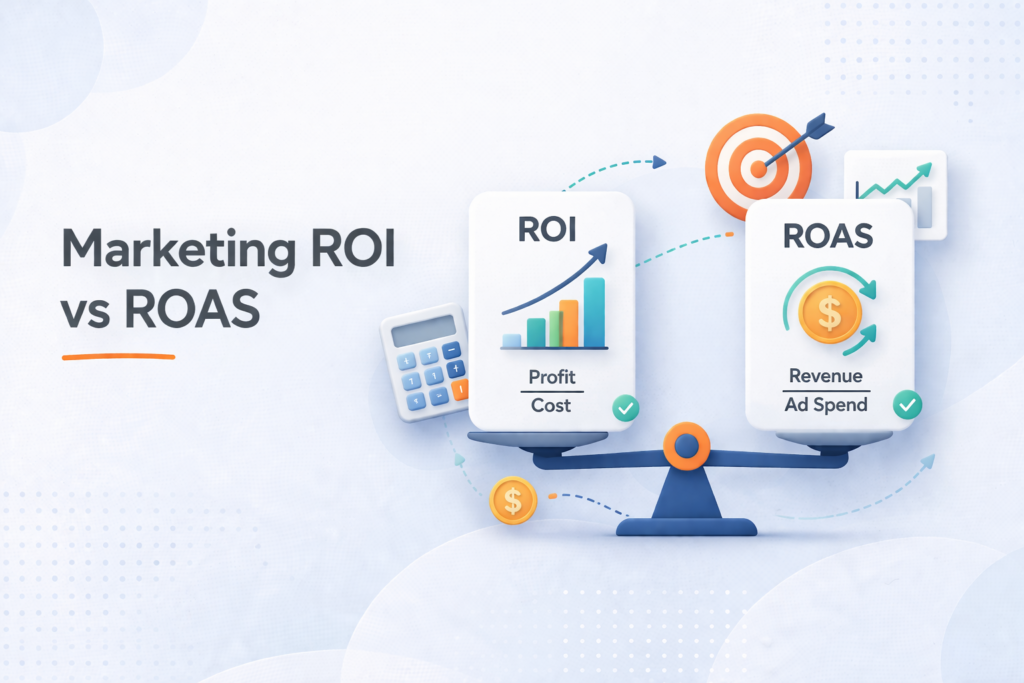
Marketing ROI and return on ad spend are related, but they measure different levels of performance.
| Metric | What it compares | Best used for |
| ROAS | Advertising revenue against advertising spend | Paid campaign optimization |
| Marketing ROI | Marketing return after relevant marketing costs | Profitability, planning, and broader investment decisions |
ROAS can show whether an advertising campaign generates revenue efficiently. However, it may exclude creative production, agency fees, software, internal resources, and other costs needed to produce the result.
Marketing ROI provides a broader financial view. It is usually more suitable for leadership reporting, budget planning, and comparing different types of marketing investment.
The dedicated comparison of marketing ROI vs ROAS explains how the formulas, cost definitions, and use cases differ.
Why Marketing ROI Matters
Marketing ROI connects campaign activity with business value. Metrics such as impressions, clicks, traffic, and leads can help diagnose performance, but they do not show whether marketing is creating an acceptable financial return.
ROI can support several important decisions.
Budget Allocation
Marketing ROI helps teams compare investments and identify where additional budget may produce the most value. However, the highest current ROI should not automatically receive all available spend.
A highly efficient channel may have limited room to scale. Another channel may have a lower current ROI but access a much larger audience or create demand that supports other campaigns.
Performance Improvement
A falling ROI can reveal problems with targeting, creative, conversion rates, lead quality, pricing, or sales follow-up. The metric helps teams identify where deeper investigation is needed.
Leadership Reporting
Marketing leaders need to explain how spend contributes to growth, pipeline, and revenue. ROI provides a financial framework that is easier to connect with broader business planning than channel activity metrics alone.
Investment Accountability
Clear ROI definitions help teams evaluate whether new campaigns, technologies, agencies, events, or content programs are producing enough value to continue.
What Affects Marketing ROI?
Marketing ROI is influenced by strategy, execution, customer behavior, and measurement quality. A change in reported ROI does not always mean the marketing itself became better or worse.
Attribution Model
The attribution model determines which channels receive credit for revenue. Last-click attribution may favor branded search, direct traffic, and remarketing because they often appear near conversion.
First-touch attribution may overvalue acquisition channels, while multi-touch models distribute credit across several interactions. Changing the attribution model can change channel-level ROI even when total revenue and spend remain unchanged.
Conversion Tracking
Missing events, duplicated conversions, inconsistent UTM parameters, and disconnected CRM records can distort marketing ROI.
A campaign may appear inefficient because conversions are undercounted. Another may appear highly profitable because one platform claims revenue that was also reported elsewhere.
Reliable ROI measurement therefore begins with accurate conversion definitions and tested tracking.
Sales Cycle Length
Long sales cycles delay the return generated by marketing. This is common in B2B, SaaS, financial services, and other considered purchases.
A campaign may create qualified opportunities today but produce closed revenue several months later. Measuring ROI too early can undervalue the campaign, while measuring it too late can slow optimization.
Conversion Rate
Marketing ROI is strongly affected by what happens after traffic arrives. Landing page quality, messaging, offer strength, checkout usability, form design, and sales response times can all influence the return.
Increasing conversion rates can improve ROI without increasing advertising spend.
Customer Quality and Retention
Two campaigns may generate the same initial revenue but attract customers with different retention, margin, or expansion potential.
A channel that acquires high-value customers may produce stronger long-term ROI even when its immediate cost per acquisition is higher.
Pricing, Margins, and Discounts
Revenue alone does not show profitability. Heavy discounts, low margins, returns, or high service costs can reduce the real return from a campaign.
Businesses focused on profitability may calculate ROI using gross profit or contribution margin rather than total revenue.
External Factors
Seasonality, market demand, competitor activity, economic changes, inventory, sales capacity, and brand awareness can affect results.
ROI reports should include relevant context so teams do not attribute every change entirely to marketing execution.
Common Marketing ROI Mistakes
One common mistake is using inconsistent definitions. If costs or revenue are calculated differently across campaigns, the final ROI figures cannot be compared fairly.
Another mistake is treating attributed revenue as proof of causation. Attribution models assign credit based on recorded interactions, but they do not prove what would have happened without the campaign.
Teams may also focus only on short-term return. This can undervalue content, brand, video, and other activities that create demand before it is captured by bottom-of-funnel channels.
Finally, a high ROI should not be interpreted without scale. A campaign returning 500% on a small budget may contribute less total profit than a larger campaign returning 150%.
How to Improve Marketing ROI
Improving marketing ROI does not always mean reducing spend. It often means improving how budget, targeting, offers, and measurement work together.
Start by validating conversion tracking and campaign naming. Connect marketing interactions with CRM or ecommerce outcomes, remove duplicate conversions, and make sure cost data is complete.
Next, review performance beyond the final click. Identify which channels create demand, which assist conversions, and which capture existing intent.
Teams should then focus on the largest operational opportunities, such as:
- Improving audience and keyword targeting
- Testing stronger offers and creative
- Increasing landing page conversion rates
- Reducing weak or duplicated spend
- Improving lead qualification and sales follow-up
- Shifting budget toward profitable customer segments
- Measuring customer value beyond the first purchase
For a more tactical implementation process, the SMB marketing ROI tracking checklist covers the data, cost, conversion, and reporting inputs needed to build a reliable measurement foundation.
How to Report Marketing ROI
Marketing ROI reports should show more than one percentage. Decision-makers need to understand the costs, return definition, attribution method, reporting period, and limitations behind the calculation.
A useful report may include:
- Marketing investment
- Attributed revenue or profit
- Marketing ROI
- ROAS where applicable
- Conversion volume and value
- Pipeline and closed revenue
- Customer acquisition cost
- Attribution model
- Sales-cycle or conversion lag
- Comparison with budget or previous periods
The focused guide to marketing ROI reporting explains how to structure these metrics for marketers, finance teams, and leadership.
Where Attributy Fits
Attributy helps marketing teams connect channel activity, campaign spend, customer journeys, conversions, pipeline, and revenue in one measurement environment.
This can make marketing ROI easier to evaluate across paid, organic, CRM, ecommerce, and offline activity. Instead of relying only on individual platform reports, teams can compare performance using more consistent cost, conversion, and attribution data.
The purpose is not to produce a perfect ROI number. It is to give marketers a clearer and more defensible basis for deciding what to scale, improve, test, or reduce.