
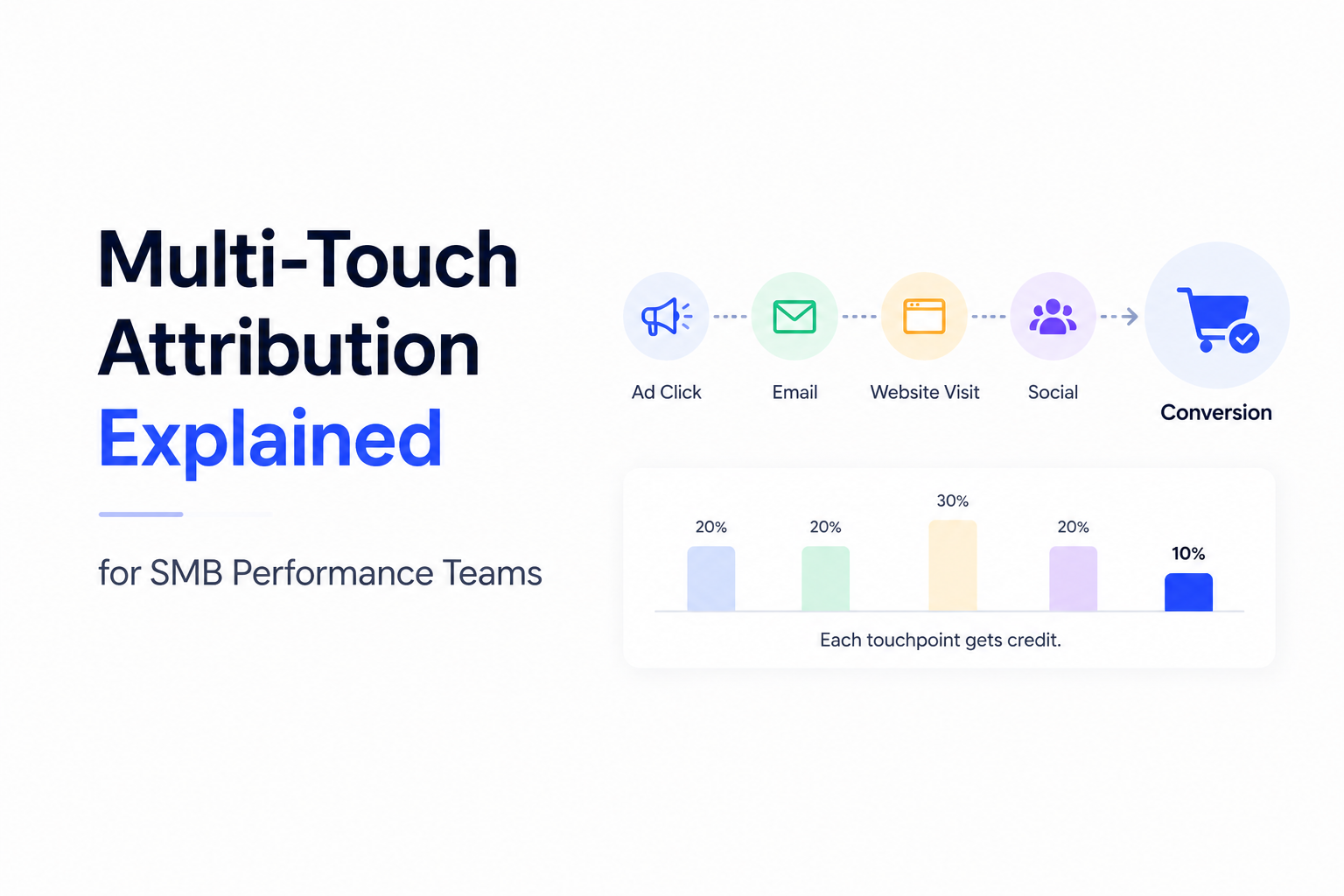
Multi-touch attribution helps marketing teams understand how several customer interactions contribute to a conversion. Instead of assigning all credit to the first or final touchpoint, it distributes credit across the channels and campaigns involved in the journey.
For SMB performance teams running paid search, paid social, organic content, email, and remarketing campaigns, this provides a more complete view of what influences leads and revenue. The goal is not to make attribution more complicated. It is to prevent budget decisions from being based on an incomplete last-click view.
What Is Multi-Touch Attribution?
Multi-touch attribution is a marketing attribution method that assigns conversion credit to multiple interactions in a customer journey. Each recorded touchpoint receives some credit based on the rules or calculations of the selected attribution model.
A typical B2B customer journey might include:
- A prospect clicks a LinkedIn advertisement.
- They return through organic search several days later.
- They subscribe to an email newsletter.
- A remarketing advertisement brings them back.
- They submit a demo request.
- A sales conversation leads to a closed deal.
A last-click model may give all credit to the remarketing advertisement or direct visit that occurred immediately before the demo request. Multi-touch attribution recognizes that earlier interactions may have introduced the brand, supported research, or encouraged the prospect to return.
This does not mean every touchpoint contributed equally. Different multi-touch models assign credit in different ways depending on how the team wants to interpret the journey.
Why Multi-Touch Attribution Matters for SMB Teams
SMB marketing teams often operate with limited budgets and smaller internal resources. When one channel is over-credited, the business may increase investment in activity that captures existing demand while reducing spend on the campaigns that created that demand.
Multi-touch attribution helps teams see how channels work together across the funnel. This can improve decisions in several areas.
More Informed Budget Allocation
A channel may generate few final-click conversions but appear frequently earlier in high-value customer journeys. Cutting that channel based only on last-click performance could reduce future pipeline.
Multi-touch reporting gives decision-makers more context before increasing, reducing, or reallocating spend. It does not automatically determine the correct budget, but it provides a stronger basis for evaluating channel contribution.
Better Visibility Into Assisted Conversions
Some campaigns introduce prospects or support consideration without receiving the final conversion credit. Measuring assisted conversions helps teams identify channels that influence outcomes even when another source closes the journey.
For example, paid social may introduce a prospect who later converts through branded search. Search captures the final action, but paid social may have created the initial awareness.
Clearer Cross-Channel Performance
Advertising platforms typically report performance from their own perspective. Meta, Google Ads, LinkedIn, and other platforms may each claim credit for the same conversion because they use different attribution windows and matching methods.
Multi-touch attribution creates a shared measurement view across channels. This makes it easier to analyze the customer journey without relying entirely on separate platform reports.
Common Multi-Touch Attribution Models
Multi-touch attribution is not one fixed calculation. Several models can be used, and each one reflects a different assumption about how marketing creates value.
| Model | How credit is assigned | Main advantage | Main limitation |
| Linear | Divides credit equally across all touchpoints | Simple and transparent | Assumes every interaction has equal influence |
| Time-decay | Gives more credit to touchpoints closer to conversion | Highlights recent conversion activity | May undervalue early demand creation |
| Position-based | Gives more credit to the first and last interactions | Balances discovery and conversion | Uses predetermined credit percentages |
| Data-driven | Uses observed journey data to estimate contribution | Can adapt to real customer behavior | Requires sufficient data and model transparency |
Linear Attribution
The linear model divides credit evenly across every recorded touchpoint.
If a customer interacts with paid search, organic content, email, and remarketing before converting, each interaction receives 25% of the credit.
This model is easy to explain and can be useful for teams beginning to evaluate full customer journeys. Its main weakness is that it treats a brief interaction and a high-intent interaction as equally important.
Time-Decay Attribution
Time-decay attribution gives more credit to interactions that happen closer to the conversion. Earlier touchpoints still receive credit, but their assigned contribution becomes smaller as the time between the interaction and conversion increases.
This model can be useful for shorter campaigns or buying cycles where recent interactions are likely to have stronger influence. However, it may undervalue awareness activity that introduced the customer much earlier.
Position-Based Attribution
Position-based attribution, sometimes called U-shaped attribution, gives the largest shares of credit to the first and last interactions. The remaining credit is divided among the middle touchpoints.
A common configuration gives 40% to the first touch, 40% to the last touch, and 20% across the middle interactions. This recognizes both customer acquisition and conversion while still accounting for nurturing activity.
Data-Driven Attribution
Data-driven attribution uses statistical analysis or machine learning to estimate how different touchpoints contribute to conversions. Unlike rule-based models, it does not rely on fixed percentages.
Its value depends on conversion volume, tracking quality, journey coverage, and the transparency of the model. Teams should understand these differences before choosing between first-click, last-click, and multi-touch attribution models.
A Practical Multi-Touch Attribution Example
Consider an SMB software company running Google Ads, LinkedIn campaigns, organic content, email nurture, and remarketing.
A prospect follows this path:
| Journey stage | Touchpoint | Possible role |
| Discovery | LinkedIn advertisement | Introduces the company |
| Research | Organic comparison article | Builds understanding and trust |
| Consideration | Email case study | Supports evaluation |
| Return visit | Google branded search | Captures active demand |
| Conversion | Direct demo request | Completes the digital conversion |
| Revenue | Sales call and closed deal | Produces the commercial outcome |
Last-click attribution may credit direct traffic or branded search. A linear model would divide credit evenly, while a position-based model would prioritize LinkedIn and the final conversion interaction.
No model can prove exactly how much each touchpoint caused the result. However, comparing these perspectives can reveal whether the team is undervaluing acquisition and nurturing activity.
How to Implement Multi-Touch Attribution
Multi-touch attribution should begin with measurement foundations, not model selection. Applying an advanced model to incomplete or inconsistent data will create more detailed reports without necessarily creating better insights.
Define Meaningful Conversions
Decide which outcomes the business needs to measure. These may include form submissions, free trials, qualified leads, opportunities, purchases, subscription revenue, or closed deals.
Early-stage conversions and revenue outcomes should be reported separately. A campaign that generates many leads may not produce the strongest pipeline or customer value.
Standardize Campaign Tracking
Use consistent UTM parameters, source classifications, campaign names, and conversion definitions. Inconsistent naming can split one campaign across several report rows or incorrectly group unrelated activity.
The team should also document how direct traffic, referral traffic, branded search, and offline interactions are handled.
Connect Marketing and Revenue Data
For B2B teams, multi-touch attribution should not end at the initial form submission. Connecting marketing activity to CRM stages helps teams evaluate qualified leads, pipeline, and closed revenue.
This is especially important when sales cycles last several weeks or months. Without CRM outcomes, campaigns may be optimized around lead volume rather than business value.
Compare Models Before Acting
Review performance under more than one model. Large differences between last-touch and multi-touch results may reveal that certain channels appear mainly at the beginning or middle of the journey.
Model comparisons should guide investigation rather than trigger automatic budget changes. Teams should also consider campaign costs, lead quality, sales feedback, seasonality, and business priorities.
Build Reports Around Decisions
Effective attribution reporting should help teams understand which channels introduce customers, which assist conversions, and which capture final demand. Reports should include conversion paths, model comparisons, spend, revenue, and cost-based efficiency metrics.
Avoid dashboards filled with metrics that do not support a clear action. A smaller set of trusted views is usually more useful than a large reporting system no one regularly uses.
Challenges and Limitations
Multi-touch attribution provides more journey visibility than single-touch reporting, but it does not eliminate measurement uncertainty.
Fragmented Data
Marketing interactions may be spread across advertising platforms, website analytics, CRM systems, email tools, ecommerce platforms, and offline records. Missing connections between these systems can create incomplete journeys.
Cross-Device and Identity Gaps
Customers may research on one device and convert on another. Privacy settings, consent choices, browser restrictions, and limited identity matching can prevent some interactions from being connected.
Offline Influence
Sales calls, events, meetings, retail visits, and word-of-mouth influence may not appear in digital conversion paths. These gaps are particularly important for businesses with long sales cycles or significant offline activity.
Attribution Is Not Incrementality
Multi-touch attribution distributes credit across recorded interactions. It does not prove what would have happened if a campaign had not run.
Incrementality experiments and marketing mix modeling answer different questions. Attribution remains valuable for journey analysis and operational reporting, but it should not be treated as perfect evidence of causation.
When SMB Teams Should Use Multi-Touch Attribution
Multi-touch attribution becomes more useful as the number of marketing channels and customer interactions increases.
| Team situation | Recommended approach |
| One primary channel and a short conversion path | A simpler model may be sufficient |
| Several digital channels with consistent tracking | Begin comparing multi-touch models |
| Long B2B sales cycle with CRM data | Connect touchpoints to pipeline and revenue |
| High data volume and mature tracking | Consider data-driven or algorithmic models |
| Significant tracking gaps | Improve data quality before adding complexity |
Teams should adopt multi-touch attribution when it supports a real decision-making need. Implementing it only because it appears more advanced can create reporting complexity without improving marketing performance.
Choosing a Multi-Touch Attribution Platform
SMB teams may be able to begin with existing analytics tools, but dedicated platforms become more relevant when data must be combined across several advertising, website, CRM, and revenue sources.
When comparing cross-channel attribution tools for SMB teams, evaluate integration coverage, implementation effort, identity matching, model transparency, CRM connectivity, reporting usability, and total cost.
The right platform should make attribution easier to operate, not simply add more models. Marketers should be able to understand how credit was assigned and use the results in campaign and budget discussions.
Where Attributy Fits
Attributy helps SMB performance teams connect marketing touchpoints across paid, organic, email, website, CRM, and revenue data. This gives teams a more unified view of customer journeys than isolated channel dashboards.
By combining multi-touch attribution with cross-channel reporting and commercial outcomes, Attributy helps marketers identify which activities introduce demand, assist consideration, and contribute to conversions. The objective is to turn attribution into a practical decision-making system rather than another reporting layer.