
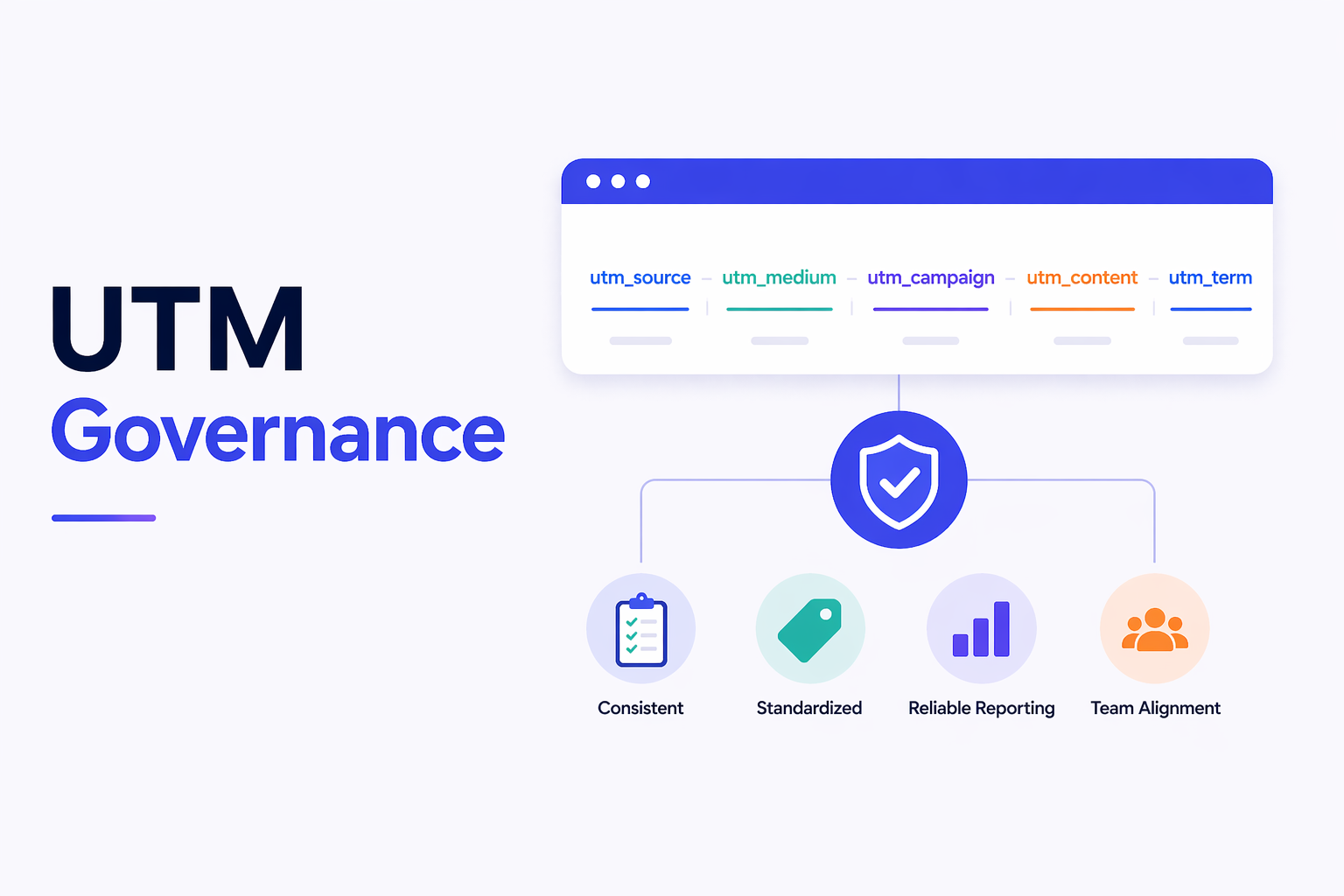
A consistent UTM naming convention helps marketing teams understand where campaign traffic comes from and how individual campaigns contribute to conversions. Without clear standards, small variations such as paid_social, paid-social, and paidsocial can split one channel into several reporting categories.
UTM governance prevents this fragmentation by defining how campaign links are created, reviewed, approved, and maintained. It turns UTM tagging from an informal campaign task into a repeatable measurement process that supports cleaner attribution reporting, conversion tracking, and cross-channel analysis.
What Is UTM Governance?
UTM governance is the set of rules, processes, and responsibilities used to manage UTM parameters across marketing campaigns.
A complete governance system defines:
- Which UTM parameters are required
- Which values are approved
- How campaign names should be structured
- Who can create or modify tagged links
- How links are checked before launch
- How naming inconsistencies are corrected
- How the taxonomy changes when new channels are added
The goal is not to create the longest possible naming document. It is to give everyone launching campaigns the same measurement language.
The underlying UTM parameters identify the source, medium, campaign, and optional details associated with a marketing link. Governance determines how those parameters should be used consistently across teams.
Why UTM Governance Matters
Most UTM problems begin gradually. A paid media specialist creates one naming pattern, the email team uses another, and an external agency follows its own conventions.
The links may still work, but reporting becomes harder to interpret.
For example, one paid social channel might appear under:
- paid_social
- paid-social
- social_paid
- cpc_social
- facebook_paid
Instead of one clean channel category, the data is divided across several labels. Teams then spend time cleaning reports, rebuilding channel groupings, or manually combining campaign results.
Poor UTM governance can cause:
| Problem | Reporting impact |
| Inconsistent source names | Traffic from one platform appears under multiple sources |
| Different medium labels | Channel-level comparisons become unreliable |
| Vague campaign names | Marketers cannot identify the offer, audience, or initiative |
| Missing parameters | Traffic may fall into referral, direct, or unclassified categories |
| Incorrect capitalization | Reporting platforms may treat values as separate entries |
| Uncontrolled agency tagging | External campaigns do not match internal reporting standards |
These issues also affect attribution. Attribution models depend on accurate source and campaign data. If the inputs are fragmented, the resulting credit allocation and reporting will also be fragmented.
What a UTM Naming Convention Should Include
A UTM naming convention defines the structure and allowed values for each parameter.
The five standard parameters are:
| Parameter | Purpose | Example |
| utm_source | Identifies the platform, publisher, or traffic source | |
| utm_medium | Identifies the channel or marketing method | paid_social |
| utm_campaign | Identifies the specific campaign or initiative | us_smb_demo_q3 |
| utm_content | Distinguishes creative, placement, CTA, or ad variation | video_customer_story |
| utm_term | Records a keyword, audience, or targeting detail | marketing_analytics |
Not every team needs to use all five parameters for every channel. However, the rules should state when each one is required and what information it should contain.
Source Naming Rules
The utm_source value should identify the specific platform or publisher sending the traffic.
Examples include:
- meta
- newsletter
- partner_name
Avoid using channel categories such as social or paid as the source. Those values belong more naturally in the medium field.
Platform names should also remain consistent. If the approved source is linkedin, team members should not alternate between linkedin, linkedin_ads, and li.
Medium Naming Rules
The utm_medium value should classify the marketing method or channel type.
A controlled medium list might include:
- cpc
- paid_social
- organic_social
- display
- affiliate
- partner
- referral
Medium values should be standardized because they often influence default and custom channel groupings.
The team should also decide how detailed these values need to be. For example, using paid_social provides a useful distinction from organic social, while using a different medium for every social platform creates unnecessary complexity.
Campaign Naming Rules
The utm_campaign value should make the campaign identifiable after it appears in a report.
A structured campaign name may include:
- Market or region
- Audience
- Product or offer
- Campaign theme
- Funnel stage
- Date, quarter, or launch period
For example:
us_smb_demo_q3
uk_customer_retention_webinar_sep
de_ecommerce_attribution_awareness_q4
Campaign names should contain enough context to support later analysis without becoming difficult to create or read.
Avoid vague values such as:
- campaign1
- test
- promotion
- new_ads
- retargeting
These names may make sense to the person creating the link, but they provide little value several months later.
Content and Term Rules
The utm_content field can distinguish creative variations, placements, formats, or calls to action.
Examples include:
- video_a
- carousel_customer_journey
- header_cta
- sidebar_banner
The utm_term field is commonly associated with paid search keywords, although some teams also use it for audience or targeting information. If your team uses it beyond keywords, document that decision clearly.
Formatting Standards to Define
A naming convention should also establish formatting rules.
A practical standard may require:
- Lowercase letters only
- No spaces
- Underscores as separators
- No unnecessary punctuation
- No personally identifiable information
- Consistent abbreviations
- One agreed date format
- English values across international teams, where appropriate
Lowercase values are especially important because some reporting environments may treat LinkedIn and linkedin as separate entries.
Separators should also be consistent. Mixing underscores, hyphens, and spaces makes campaign names harder to filter and compare.
How to Build a UTM Governance Framework
1. Audit Existing UTM Values
Begin by reviewing the source, medium, campaign, content, and term values already appearing in analytics and attribution reports.
Look for:
- Duplicate values with different spellings
- Uppercase and lowercase variations
- Unclear campaign names
- Missing parameters
- Obsolete channel labels
- Agency or regional naming differences
- Personally identifiable information inside URLs
The audit will show where the current system is breaking and which values should be consolidated.
This review can also form part of a wider attribution audit when campaign totals differ between analytics, advertising, CRM, and reporting platforms.
2. Create a Controlled Taxonomy
A controlled taxonomy is a list of approved values and naming patterns.
Source and medium fields should usually be more controlled because they support channel-level reporting. Campaign names can allow more flexibility, but they should still follow a defined structure.
A basic taxonomy could look like this:
| Parameter | Rule | Approved example |
| utm_source | Platform or publisher name | |
| utm_medium | Approved channel classification | paid_social |
| utm_campaign | Region + audience + offer + period | us_smb_demo_q3 |
| utm_content | Creative or placement identifier | video_a |
| utm_term | Keyword or approved targeting detail | attribution_software |
The taxonomy should be detailed enough to prevent ambiguity but simple enough for teams to use without constant support.
3. Define Channel-Specific Requirements
Different channels may require different parameters.
| Channel | Required parameters |
| Paid search | Source, medium, campaign, content, term |
| Paid social | Source, medium, campaign, content |
| Source, medium, campaign | |
| Organic social | Source, medium, campaign |
| Partnerships | Source, medium, campaign |
| QR codes or offline links | Source, medium, campaign |
Channel-specific templates reduce uncertainty and help marketers create complete links without over-tagging every campaign.
4. Use a Centralized UTM Builder
Teams should avoid creating UTM links manually whenever possible.
A shared spreadsheet, form, internal builder, or campaign management system can validate approved values and generate URLs automatically. Dropdown menus can control source and medium values, while required fields prevent incomplete links.
The builder should also store each generated URL. This creates a campaign record that can be reviewed later if reporting issues appear.
5. Assign Ownership
A governance system needs a clear owner.
The owner may sit within marketing operations, analytics, performance marketing, or another measurement function. Their responsibilities should include:
- Maintaining the taxonomy
- Approving new values
- Updating channel templates
- Training internal and external teams
- Reviewing compliance
- Coordinating corrections
Ownership does not mean one person must build every link. It means someone is responsible for keeping the system consistent.
6. Add Pre-Launch QA
UTM links should be checked before campaigns go live.
A pre-launch review should confirm:
- The destination URL works.
- Required parameters are present.
- Values follow the approved taxonomy.
- Capitalization and separators are correct.
- No sensitive or personal data appears in the URL.
- Redirects do not remove the parameters.
- The final landing page records the expected source data.
For large campaign launches, test visits should also be reviewed inside analytics or reporting tools before full activation.
7. Run Periodic Audits
UTM governance requires ongoing maintenance.
Monthly or quarterly audits can identify:
- New unapproved source or medium values
- Typographical errors
- Campaigns missing required parameters
- Agency or partner inconsistencies
- Old values that should be retired
- New channels requiring taxonomy updates
The audit should result in both corrections and process improvements. Repeated errors may indicate that the naming rules are unclear or that the UTM builder needs stronger validation.
How UTM Governance Improves Attribution Reporting
UTM governance does not determine how conversion credit is assigned, but it improves the quality of the campaign data used in that process.
Consistent naming makes it easier to:
- Group traffic into reliable channels
- Compare campaigns over time
- Analyze conversion paths
- Identify assisted influence
- Connect campaign data with CRM outcomes
- Calculate channel-level ROI
- Investigate reporting discrepancies
Clean campaign inputs are especially important for attribution reporting because stakeholders need to understand which sources, campaigns, and touchpoints contributed to reported outcomes.
Even advanced attribution models cannot fully compensate for inconsistent campaign tagging. Better modeling still depends on better data.
Common UTM Governance Mistakes
One mistake is making the taxonomy too complicated. If campaign creators need a long manual to tag one link, they are more likely to avoid the system or create their own shortcuts.
Another mistake is documenting rules without building them into the campaign workflow. A naming guide stored in a folder is not enough if agencies, freelancers, and regional teams do not use it.
Teams should also avoid changing historical values casually. Renaming a medium from paid_social to social_paid can break trend comparisons unless the reporting system maps both values consistently.
Finally, UTMs should not contain names, email addresses, customer identifiers, or other personal information. Parameters can appear in browser histories, analytics tools, shared URLs, and external systems.
Where Attributy Fits
Attributy helps marketing teams connect campaign, channel, conversion, spend, and revenue data across the customer journey. A consistent UTM governance system improves the quality of those inputs and makes cross-channel reporting easier to interpret.
The platform cannot replace the need for clear naming standards. Instead, reliable UTM data gives attribution and reporting systems a stronger foundation for showing which campaigns influence conversions and revenue.