
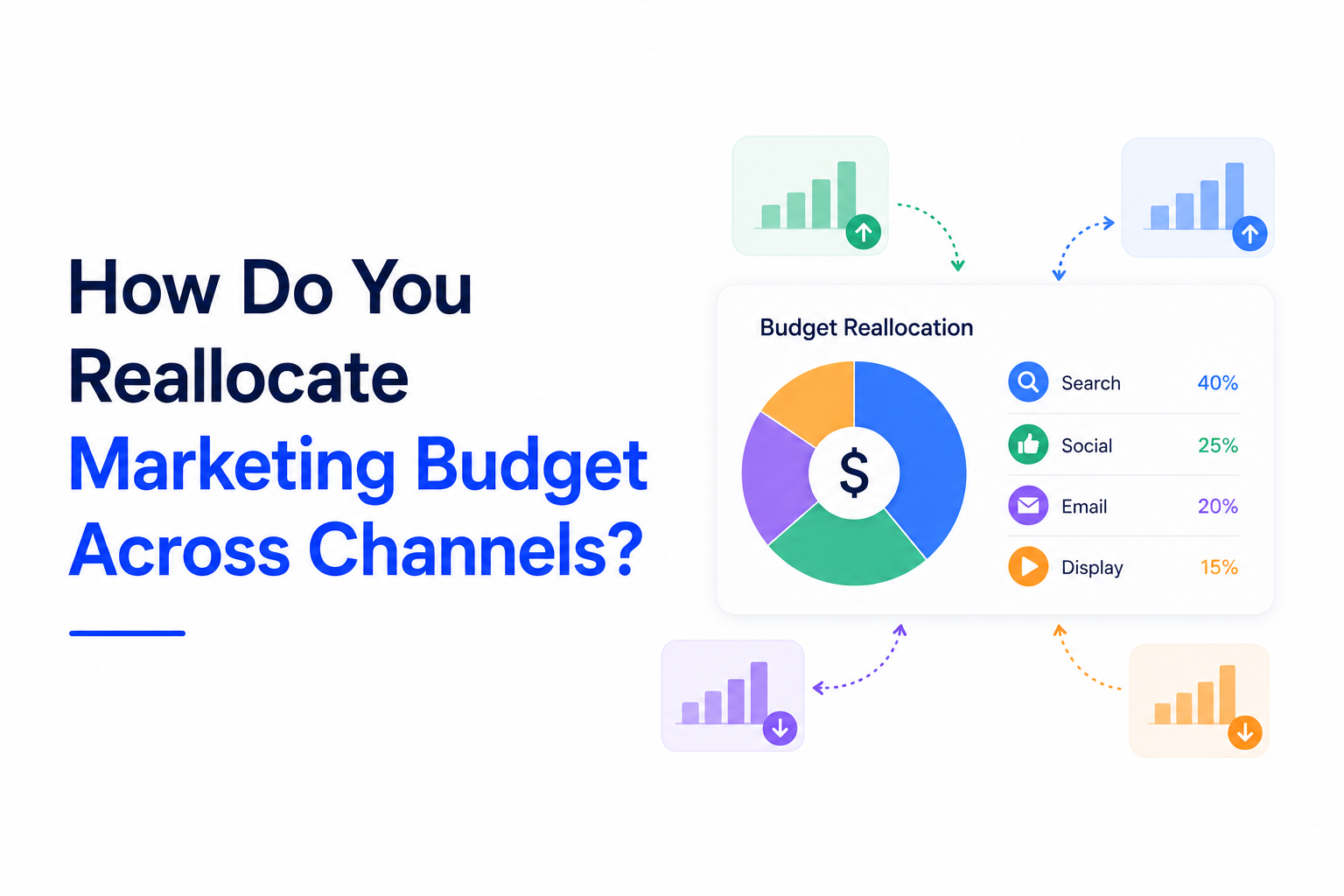
You reallocate marketing budget by moving spend away from channels with weak incremental performance, limited capacity, or declining returns and directing it toward channels with stronger business outcomes and more room to scale.
The decision should not be based only on which platform reports the highest ROAS. Marketers also need to consider conversion quality, pipeline, revenue, channel role, saturation, and what the next portion of spend is likely to produce.
Start With the Business Outcome
Before comparing channels, define the result the budget is expected to improve. This may be closed revenue, qualified pipeline, purchases, customer acquisition cost, or another commercially meaningful outcome.
Different channels may support different stages of the journey. Paid search may capture existing demand, while paid social, content, or events may introduce prospects earlier. Comparing every channel using the same short-term conversion metric can therefore produce poor allocation decisions.
A useful review begins with a table like this:
| Channel | Primary role | Main outcome | Current concern |
| Paid search | Demand capture | Qualified conversions | Rising acquisition cost |
| Paid social | Demand creation | Influenced pipeline | Weak last-click reporting |
| Retargeting | Conversion support | Completed conversions | High frequency |
| Events | Education and pipeline | Opportunities created | Long conversion delay |
This context helps distinguish a genuinely weak channel from one that is being evaluated using the wrong metric.
Review Performance and Data Quality
Budget reallocation should begin only after confirming that the underlying data is reliable. Missing conversion events, inconsistent UTM parameters, disconnected CRM stages, and different attribution windows can make one channel appear stronger or weaker than it is.
Review spend, conversion rate, cost per qualified conversion, pipeline, closed revenue, and sales-cycle length. An effective attribution reporting setup can also show whether a channel tends to introduce customers, assist later interactions, or close conversions.
The most useful comparison depends on the business model:
| Performance signal | What it can reveal |
| Cost per qualified lead | Whether lower-cost leads are commercially useful |
| Opportunity rate | Whether leads progress into the sales pipeline |
| Revenue contribution | Whether the channel creates financial value |
| Assisted influence | Whether the channel supports later conversions |
| Conversion lag | Whether results need more time to appear |
| Frequency and reach | Whether the audience is becoming saturated |
A channel with a high cost per lead may still deserve investment if its leads close at a much higher rate. A low-cost channel may deserve less budget when it generates volume without qualified outcomes.
Evaluate Marginal Returns and Saturation
Historical averages show what previous spend produced. They do not show what the next dollar will generate.
For example, a paid search campaign may perform efficiently at $10,000 per month because it captures the available high-intent demand. Increasing the budget to $20,000 may force the campaign into broader keywords or more expensive auctions, causing acquisition costs to rise.
This is a marginal-return problem. The additional budget produces less value than the existing budget.
Signs of saturation may include rising cost per acquisition, limited audience growth, higher ad frequency, declining conversion rates, and increased spend without proportional revenue growth.
A channel should not receive more budget simply because its average ROAS is currently high. The team should ask whether it can absorb additional investment without losing too much efficiency.
Reallocate Budget Gradually
Large budget shifts make it difficult to understand what caused the result and may disrupt campaign learning. A better process is to move budget in controlled stages.
Start by reducing spend from campaigns with weak qualified outcomes, clear saturation, or persistent inefficiency. Direct a limited portion of that budget toward channels with stronger marginal performance or promising early results.
Record the expected outcome before making the change. For example:
| Budget change | Expected result | Review period |
| Move 10% from retargeting to non-brand search | More qualified new-customer demand | Four weeks |
| Reduce a saturated audience by 15% | Lower frequency with limited conversion loss | Two weeks |
| Increase a promising campaign by 10% | More pipeline without major CPA increase | One sales cycle |
The review period should reflect the channel and sales cycle. Ecommerce changes may produce results quickly, while B2B reallocations may need several weeks or months before revenue becomes visible.
For larger allocation decisions, the broader marketing budget allocation framework can help teams balance proven activity, promising channels, and controlled experiments.
Validate the Result
After the test period, compare actual performance with the original expectation. Review whether the receiving channel maintained efficiency and whether reducing spend elsewhere caused any unexpected decline.
Do not rely only on platform-reported conversions. Check qualified outcomes, CRM pipeline, purchases, revenue, and assisted journeys where relevant.
If the result is positive, the team can make another gradual adjustment. If performance declines, the budget may need to be restored, the campaign may need further optimization, or the original assumption may have been incorrect.
Common Reallocation Mistakes
One common mistake is moving budget after a short period of weak performance. Seasonality, sales delays, creative fatigue, and temporary tracking issues can all affect results.
Another is shifting all available spend into demand-capture channels. This may improve short-term reporting while reducing the activity that creates future demand.
Teams should also avoid treating automated recommendations as final decisions. AI and optimization tools can identify patterns, but marketers still need to account for margins, sales capacity, customer quality, and strategic priorities.
Marketing budget reallocation works best as an ongoing process of measuring, testing, and learning. The goal is not to find one permanent channel mix, but to direct spend toward the strongest available opportunity while protecting the wider customer journey.