
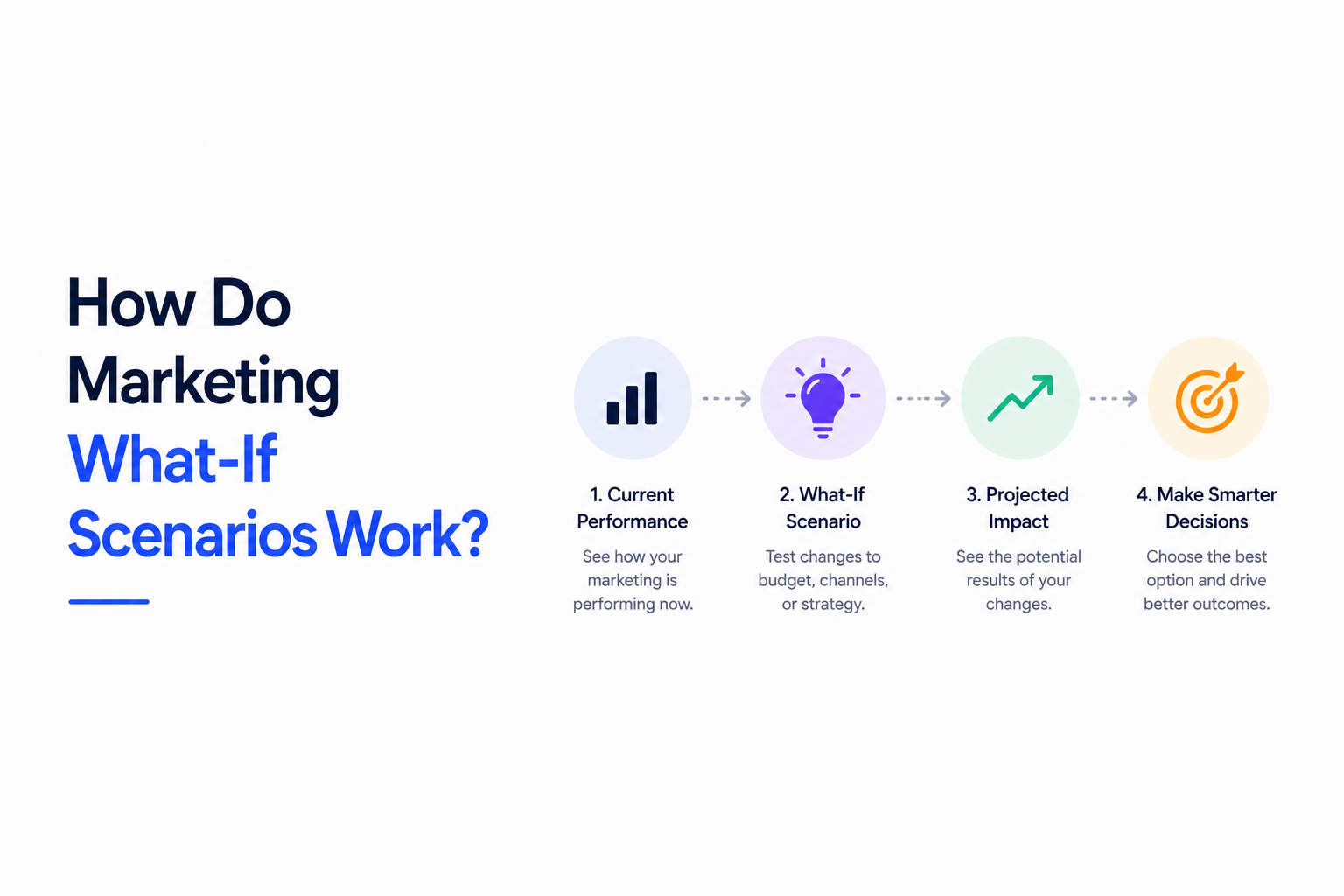
Marketing what-if scenarios are planning exercises that estimate how changes in budget, channel mix, targeting, timing, or campaign strategy could affect performance before those changes are made. Instead of guessing what might happen if paid search spend increases or social budget decreases, marketers use historical data, attribution insights, incrementality signals, and performance trends to model possible outcomes.
In practice, marketing what-if scenarios help teams answer questions such as: What happens if we shift 20% of budget from one channel to another? Will a campaign keep scaling, or has it already reached saturation? Where are marginal returns still strong? This makes scenario planning useful for teams that want to improve performance without relying only on last-click reports or instinct.
At Attributy, we see what-if analysis as most useful when it connects planning with measurement. A scenario is only as strong as the data behind it, which is why clean conversion tracking, attribution reporting, and realistic assumptions matter.
Why Marketing What-If Scenarios Matter
Marketing budgets are rarely static. Teams regularly need to decide whether to increase spend, reduce waste, test new channels, or rebalance campaigns across paid search, paid social, email, affiliates, and other sources. What-if scenarios make those decisions more structured by showing likely outcomes before money is moved.
For example, a team may find that one channel has a strong ROAS at current spend, but the next budget increase may produce weaker marginal returns because the audience is already saturated. Another channel may look less efficient on the surface but create more assisted conversions earlier in the journey. Without scenario planning, these tradeoffs are easy to miss.
Good what-if analysis usually considers:
- Budget shifts between channels
- Marginal returns from additional spend
- Saturation points where performance starts to decline
- Incrementality, or whether a channel creates new conversions
- Attribution impact across the full customer journey
This is also where agentic AI for marketing optimization can become useful. AI can help monitor performance changes, surface optimization opportunities, and recommend possible budget reallocations, but marketers still need to validate assumptions before acting.
How to Use What-If Scenarios in Marketing
Start by defining the decision you need to make. A vague scenario like “What if we spend more?” is less useful than “What if we move 15% of paid social budget into branded and non-branded search next month?” Clear inputs create clearer outputs.
Next, review performance data from your attribution and reporting setup. Look at channel-level conversions, assisted conversions, cost per acquisition, conversion quality, and revenue impact. For more advanced planning, teams may also compare attribution results with incrementality tests to understand which conversions are genuinely influenced by marketing activity.
The most common mistake is treating what-if scenarios as predictions instead of estimates. They do not guarantee future results. Market conditions, seasonality, creative fatigue, competitor activity, and tracking gaps can all affect performance. The goal is not to predict perfectly, but to make better-informed decisions with fewer blind spots.
For teams trying to connect scenario planning with actual revenue impact, attribution reporting is often the foundation. It helps show how channels contribute before and after budget changes, so marketers can compare the scenario against real results.
If you want to understand how Attributy helps teams measure performance and make smarter budget decisions, you can Book a demo.