
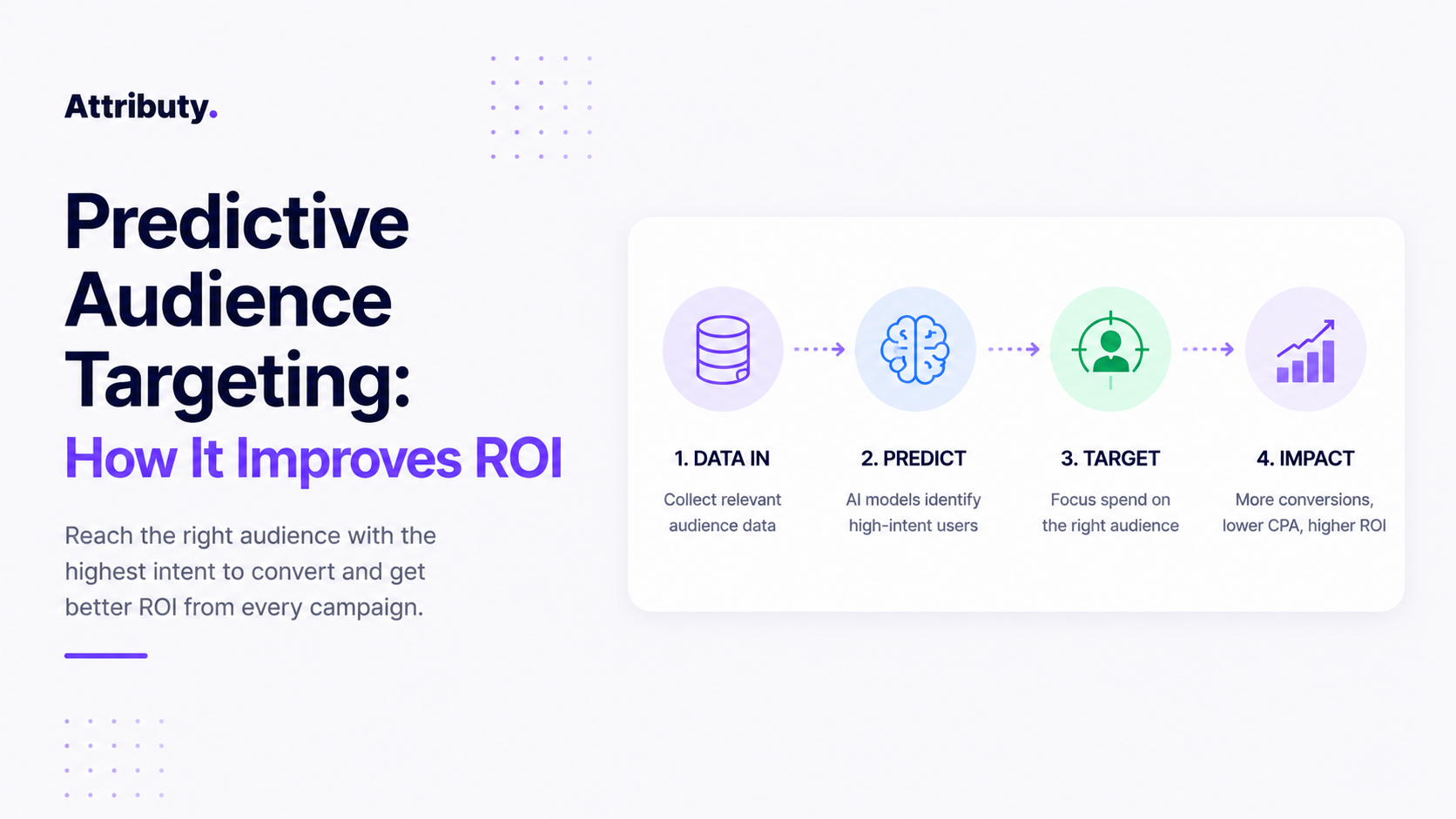
Predictive audience targeting improves ROI by helping marketers direct budget, bids, messaging, and follow-up toward users or accounts with a stronger likelihood of producing valuable outcomes. Instead of treating every audience member equally, it uses historical behavior, intent signals, customer data, and conversion patterns to identify where marketing investment has greater potential.
The objective is not simply to generate more clicks or reach a larger audience. It is to increase the share of spending that reaches qualified prospects, reduce investment in low-probability segments, and improve the value created by each campaign.
Predictive targeting can support these decisions, but it does not guarantee results. Its effect on ROI depends on the quality of the data, the outcome being predicted, the campaign action connected to the prediction, and how accurately performance is measured afterward.
What Is Predictive Audience Targeting?
Predictive audience targeting is the use of statistical or machine-learning models to estimate which users, leads, accounts, or customer segments are most likely to complete a specific action.
The predicted action might be requesting a demo, making a purchase, becoming a qualified opportunity, renewing a subscription, or increasing product usage. Because each outcome represents a different behavior, teams may need separate models for acquisition, qualification, retention, and expansion.
Predictive targeting usually combines several types of information:
| Data category | Example inputs |
| Website behavior | Product views, pricing visits, repeat sessions |
| Campaign engagement | Ad clicks, email responses, content downloads |
| CRM information | Lead stage, account status, sales activity |
| Customer history | Purchases, renewals, average order value |
| Product behavior | Trial activity, feature usage, account engagement |
| Firmographic data | Company size, industry, role, market |
A model evaluates patterns associated with previous outcomes and assigns a probability or score to current audience members. Marketers can then use those predictions to inform campaign targeting, bidding, personalization, and sales prioritization.
How Predictive Targeting Can Improve ROI
Predictive audience targeting improves ROI through several connected mechanisms. It can reduce wasted exposure, improve conversion quality, and help teams allocate campaign resources according to expected value rather than audience size alone.
It Reduces Spend on Low-Probability Audiences
Broad targeting can generate reach, but much of that exposure may go to users who are unlikely to complete the desired action.
Predictive targeting helps identify audience members whose behavior and characteristics resemble those of previous converters. Lower-probability users can receive less budget, different messaging, or longer-term nurture instead of being treated as immediate conversion opportunities.
This does not mean that lower-intent audiences have no value. They may simply require a different campaign goal and cost expectation. Predictive targeting is most useful when it aligns the level of investment with the audience’s current likelihood and potential value.
It Improves Conversion Quality
A campaign optimized for all form submissions may produce many leads without generating qualified pipeline. Predictive targeting can help distinguish between users likely to complete an easy conversion and those more likely to become customers.
For example, two prospects may submit the same form. One may match the ideal customer profile, return to product pages, and engage with sales-related content. The other may provide incomplete information and show no further activity.
Prioritizing the first prospect can improve lead-to-opportunity rates even if the total number of leads remains unchanged. The ROI gain comes from improving the quality of the outcome rather than simply increasing conversion volume.
It Supports Value-Based Bidding
Advertising platforms can optimize delivery more effectively when they receive signals connected to business value.
If every form submission is treated as equal, an automated bidding system may find the least expensive users likely to submit the form. Those users may not be the most likely to become qualified opportunities or customers.
Predictive scores can help teams define more valuable conversion signals, build higher-priority audience segments, and send qualified lead or revenue outcomes back to advertising platforms. The result can be a better connection between bidding optimization and actual business performance.
It Improves Audience Prioritization
Predictive targeting allows marketers to rank audiences by expected conversion probability or value.
A B2B SaaS company might combine company size, product engagement, CRM stage, and high-intent website behavior. An ecommerce business might evaluate product views, cart activity, purchase history, discount sensitivity, and time since the last order.
The resulting propensity scores provide a practical way to compare audience members. High-scoring users might receive stronger remarketing, personalized offers, or faster sales follow-up, while lower-scoring users enter broader education or nurture campaigns.
The Role of Intent Signals
Predictive models depend on signals that provide useful evidence about customer readiness or value. These signals may come from recent behavior, long-term customer history, account attributes, or combinations of several interactions.
A pricing-page visit may suggest stronger immediate intent than reading a broad educational article. Repeated product activity may be more useful than one isolated click. For B2B companies, a prospect’s role and company profile may add context to that behavior.
However, the value of an intent signal depends on the outcome being predicted. A content download may correlate with qualified pipeline for one company and produce little commercial value for another.
Teams should therefore validate intent signals in marketing against actual conversions, pipeline, or revenue rather than assigning value based only on intuition.
The timing of a signal also matters. A pricing visit from yesterday may carry more relevance than the same interaction from six months ago. Many scoring approaches therefore include recency, frequency, and sequence alongside the action itself.
How to Implement Predictive Audience Targeting
Define One Outcome Clearly
Start with one specific action that the model should estimate. Broad goals such as “find good customers” are difficult to model because they do not define what success means.
A more useful outcome might be:
- Becoming a qualified opportunity within 60 days
- Completing a first purchase
- Renewing a subscription
- Generating a specific level of customer revenue
Different outcomes should not be mixed without clear rules. A user likely to request a demo is not necessarily the same as one likely to become a profitable customer.
Connect the Necessary Data
The model needs enough relevant data to identify patterns associated with the outcome. This may require connecting advertising interactions, website behavior, CRM stages, transaction history, and product activity.
Data quality matters more than the number of available fields. Duplicate conversions, incomplete CRM records, and inconsistent customer identifiers can teach the model the wrong relationships.
Teams should also consider whether the available data represents current customers and market conditions. A model trained on an old product, pricing structure, or target audience may become less reliable after the business changes.
Create Actionable Segments
A prediction only creates value when it changes a marketing decision.
Instead of producing one score that nobody uses, convert predictions into practical segments. For example, users might be divided into high, medium, and low conversion-probability groups.
| Segment | Possible action |
| High probability | Stronger bids, sales alerts, conversion-focused offers |
| Medium probability | Remarketing, product education, nurture |
| Low probability | Broader awareness, limited bidding, exclusion from costly campaigns |
| High value but longer term | Account-based campaigns or extended nurture |
The treatment should reflect both probability and expected value. A smaller group with a lower immediate conversion rate may still deserve investment if its potential revenue or retention value is significantly higher.
Test Against a Baseline
Predictive targeting should be compared with a credible alternative. This may be existing targeting, random audience allocation, rule-based scoring, or a control group that does not use the predictive segment.
Without a baseline, improved results may be incorrectly attributed to the model when they were caused by seasonality, creative changes, market demand, or another campaign adjustment.
Testing should also limit the number of simultaneous changes. If the audience, bid strategy, offer, creative, and landing page all change at once, the team cannot determine whether predictive targeting caused the performance difference.
How to Measure ROI From Predictive Targeting
Measuring predictive targeting requires more than reviewing click-through rates or platform conversion totals. The analysis should determine whether the approach improved commercially meaningful outcomes relative to its cost.
Useful metrics include:
| Metric | What it reveals |
| Cost per qualified conversion | Whether spending reaches stronger prospects |
| Lead-to-opportunity rate | Whether lead quality improves |
| Opportunity-to-customer rate | Whether predicted leads generate customers |
| Revenue per audience segment | Whether high-scoring groups create more value |
| Customer acquisition cost | Whether acquisition becomes more efficient |
| Marketing ROI | Whether financial return improves after broader costs |
| Customer lifetime value | Whether targeting attracts longer-term value |
| Sales-cycle length | Whether prioritized audiences convert faster |
A campaign may reduce cost per lead while producing weaker pipeline, or increase cost per lead while creating substantially more revenue. That is why the final evaluation should connect campaign costs with qualified outcomes and financial value.
The broader marketing ROI framework helps teams account for the costs and revenue used to determine whether predictive targeting produced a genuine return.
Why Attribution Still Matters
Predictive targeting estimates who is likely to convert. Attribution examines which recorded channels and touchpoints were involved in previous conversions.
These methods answer different questions, but they become more useful when connected. A model may identify a high-value audience, while attribution helps show whether paid search introduced that audience, email supported progression, or remarketing appeared near conversion.
Reliable attribution reporting can also help validate whether predictive segments produce value across channels or only inside one advertising platform.
However, attribution credit should not automatically be treated as proof that a touchpoint caused the outcome. Experiments and holdout groups may still be needed when teams want to determine whether predictive targeting produced incremental conversions.
Common Predictive Targeting Mistakes
One mistake is using weak conversion events as the target. A model trained to predict button clicks or low-quality form submissions may become very effective at finding activity that does not produce revenue.
Another is treating the score as permanent. Customer behavior, campaigns, pricing, and market conditions change. Models and scoring thresholds should be reviewed against recent outcomes and updated when their accuracy declines.
Teams can also become too aggressive in excluding low-probability audiences. This may reduce demand creation, limit the model’s ability to learn from new users, and overlook valuable customers with unusual journeys.
Predictive targeting may also reproduce bias found in historical data. If previous campaigns underinvested in a particular market or customer type, the model may interpret limited past conversions as low potential. Human review remains important when deciding how predictions affect access, budget, and follow-up.
Where Attributy Fits
Attributy helps teams connect campaign activity, customer journeys, conversion data, CRM outcomes, and revenue reporting.
This measurement foundation makes predictive insights more useful because audience decisions can be evaluated against downstream performance rather than isolated platform metrics. Marketers can examine whether prioritized segments create better conversions, pipeline, and revenue across channels.
Predictive audience targeting should support judgment rather than replace it. Its value comes from combining probability estimates with accurate measurement, controlled testing, and clear business goals.