
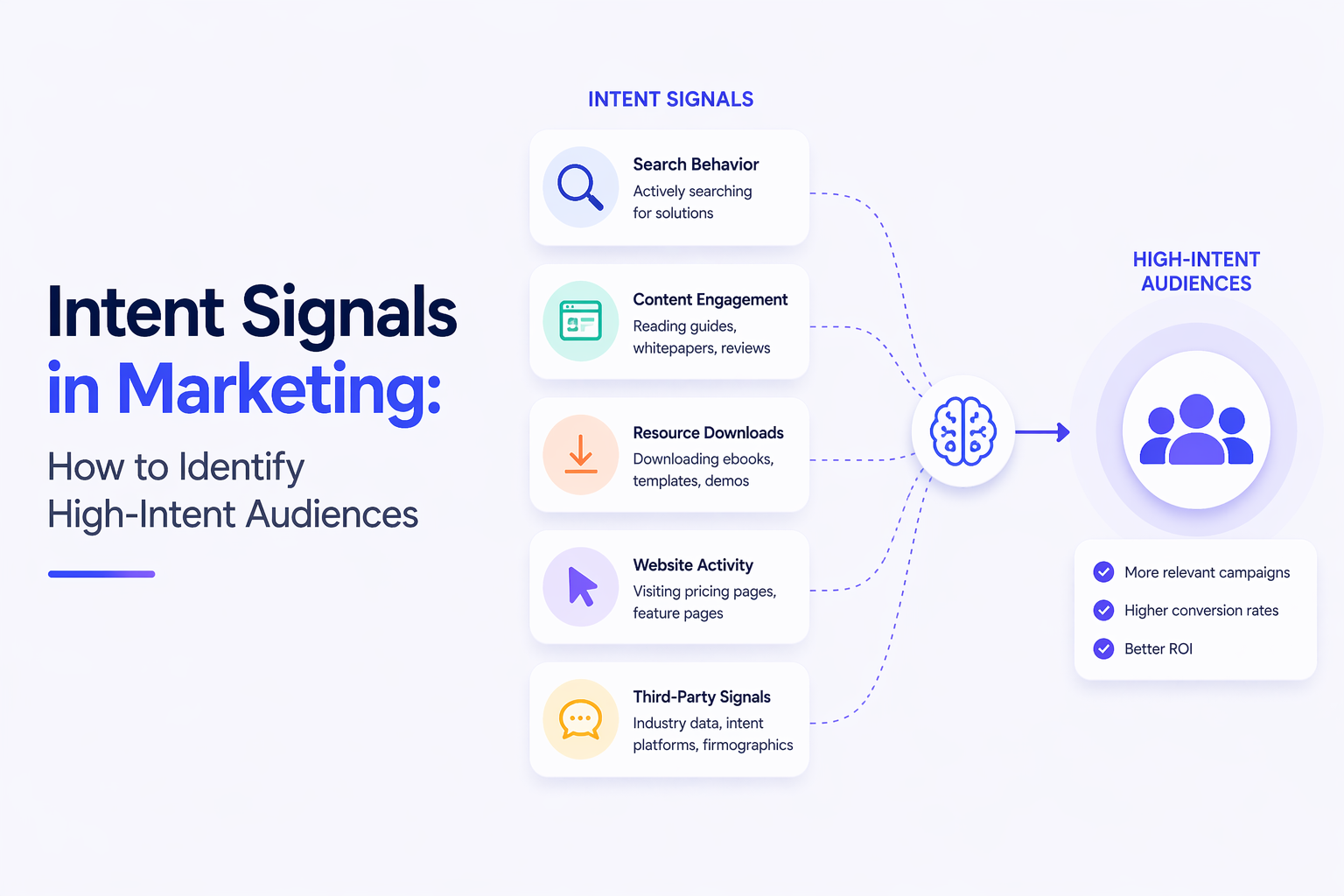
High-intent audiences are groups of users who show stronger signs that they may complete a valuable action, such as requesting a demo, starting a trial, making a purchase, or contacting sales. Marketers identify these audiences by analyzing intent signals such as page visits, repeat sessions, search behavior, campaign engagement, and CRM activity.
A single action rarely proves that someone is ready to convert. The most reliable approach is to combine several signals and validate whether those behaviors are actually associated with conversions.
What Are Intent Signals in Marketing?
Intent signals are actions or attributes that suggest where a person is in the buying journey. Some signals indicate general interest, while others suggest active evaluation or purchase readiness.
For example, reading an introductory blog article may show early-stage interest. Repeatedly visiting pricing, comparison, integration, or demo pages usually indicates stronger commercial intent.
| Intent level | Example signals | Likely journey stage |
| Low | One blog visit, brief session, broad informational search | Awareness |
| Medium | Multiple visits, product content engagement, email clicks | Consideration |
| High | Pricing views, demo visits, branded search, form starts | Evaluation or conversion |
| Post-conversion | Upgrade pages, renewal content, product usage changes | Retention or expansion |
The value of a signal depends on the business. A pricing-page visit may be highly relevant for SaaS, while an abandoned checkout may be more useful for ecommerce.
How to Identify High-Intent Audiences
Define the Conversion First
Start by identifying the action the audience should be likely to complete. This might be a purchase, demo request, qualified lead, subscription upgrade, or another business outcome.
A high-intent audience for a newsletter signup will look different from one built around closed revenue. Clear conversion definitions prevent teams from assigning importance to activity that does not support the intended goal.
Identify Behaviors That Precede Conversion
Review the journeys of users who previously converted and look for recurring actions. Useful signals may include:
- Visiting pricing, product, comparison, or demo pages
- Returning to the website several times
- Searching for the brand or product category
- Starting but not completing a form or checkout
- Engaging with product-focused emails
- Downloading decision-stage content
- Matching a high-value company or customer profile
The strongest signals are usually those that appear consistently before valuable conversions, not simply those that generate the most clicks.
Build an Audience Scoring System
Audience scoring assigns different values to behaviors according to their expected importance.
For example:
| User action | Example score |
| Reads a general educational article | 2 points |
| Returns within seven days | 5 points |
| Views a product comparison | 8 points |
| Visits the pricing page | 10 points |
| Starts a demo form | 15 points |
A user who collects 20 or more points might enter a high-intent segment. The threshold should be tested rather than chosen arbitrarily.
More advanced teams may use conversion propensity modeling to estimate conversion likelihood from several behavioral, campaign, and customer attributes instead of relying only on fixed scores.
Add Source and Customer Context
Behavior should be evaluated alongside the user’s source, audience profile, and previous interactions.
A pricing-page visit from a returning branded-search user may indicate stronger intent than the same page visit from an accidental referral. For B2B teams, company size, industry, role, CRM stage, and previous sales activity can add important context.
However, firmographic fit should not replace behavioral evidence. A company may match the ideal customer profile but still show no active buying intent.
How Marketers Use High-Intent Audiences
High-intent segments can support several practical workflows:
- Prioritizing retargeting campaigns
- Adjusting bids for valuable audience groups
- Triggering product-focused email sequences
- Alerting sales teams about engaged accounts
- Personalizing landing pages or offers
- Excluding existing high-intent users from broad awareness campaigns
These segments can also improve predictive audience targeting by helping teams focus media investment on users with stronger conversion potential.
The goal is not to stop marketing to lower-intent audiences. Early-stage users may still become valuable customers later. High-intent identification simply helps teams match budget, messaging, and follow-up to the user’s current level of readiness.
Common Mistakes to Avoid
One common mistake is treating one action as definitive proof of intent. A user may visit pricing for research, competitor analysis, or reasons unrelated to a purchase.
Another mistake is using engagement metrics without validating them against conversions. Time on page, video views, and email opens may look positive but do not always predict commercial outcomes.
Audience scoring should also be reviewed regularly. Campaigns, products, customer behavior, and sales cycles change, which means previously useful signals may lose predictive value.
Finally, teams should avoid using high-intent segments as an automatic decision system. Scores and predictions should guide targeting and prioritization while marketers continue monitoring cost, conversion quality, and revenue outcomes.