
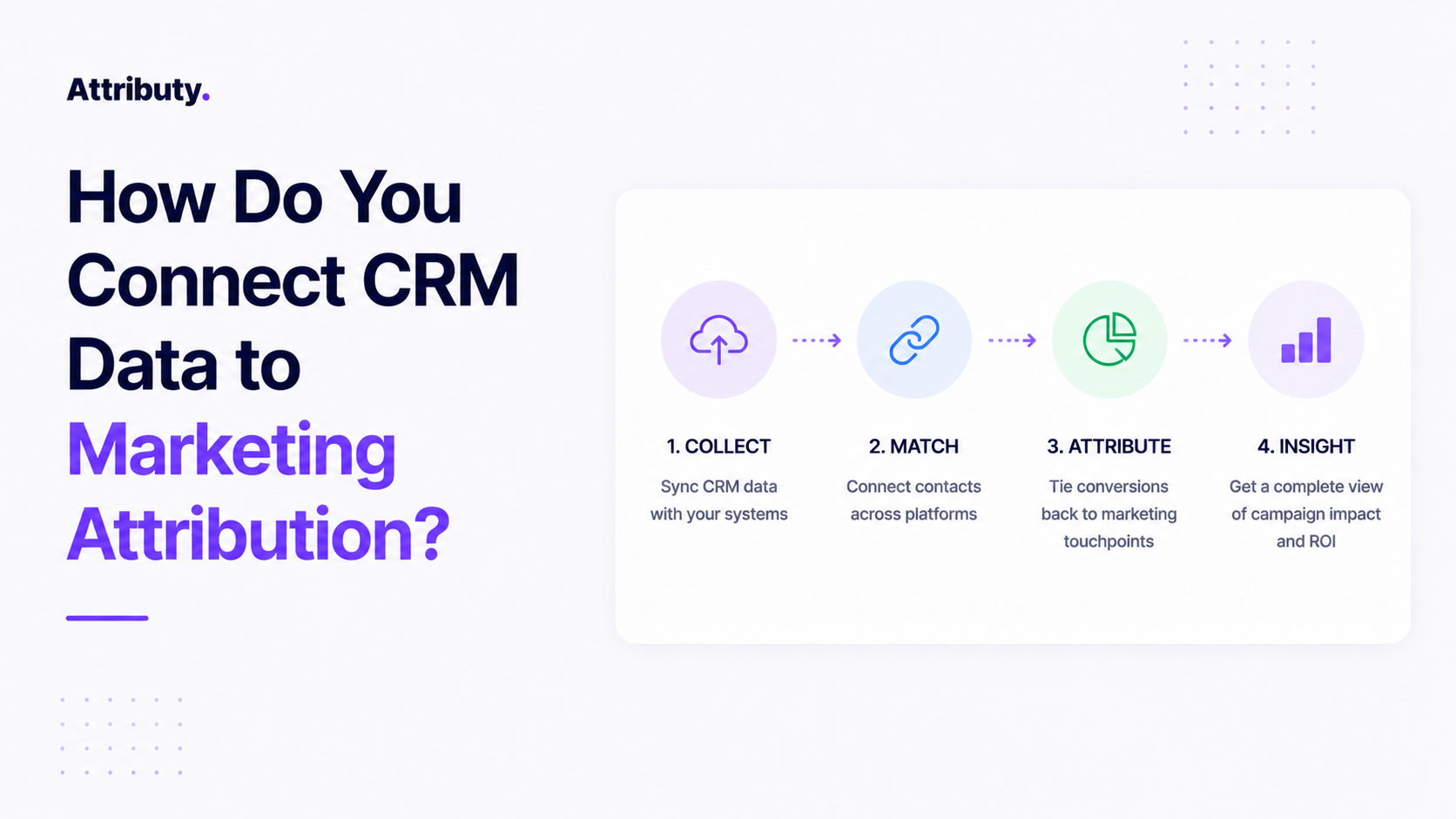
Connecting crm to marketing attribution gives marketing and sales teams a clearer view of which campaigns, channels, and touchpoints influence pipeline and revenue. Without CRM data, attribution often stops at form fills, demo requests, or ecommerce conversions. That can be useful, but it does not show whether those conversions became qualified opportunities, closed deals, repeat purchases, or high-value customers.
A strong CRM integration connects marketing touchpoints with lead records, opportunity stages, deal values, and customer outcomes. This makes marketing measurement more useful because teams can move beyond lead volume and start analyzing revenue attribution, offline conversions, and channel performance across the full customer journey.
Why CRM Data Matters for Marketing Attribution
Most marketing platforms are designed to measure digital engagement. They can show clicks, sessions, form submissions, and ad conversions, but they usually do not know what happened after a lead entered the sales process. That creates a gap between marketing activity and actual business results.
CRM data fills that gap. It helps connect a campaign touchpoint to later events such as sales-qualified lead status, opportunity creation, closed-won revenue, churn risk, or renewal value. For B2B, SaaS, lead generation, and high-consideration purchases, this is critical because the first conversion is rarely the final business outcome.
For example, one paid search campaign may generate many leads but few opportunities. Another campaign may generate fewer leads but a higher close rate and larger deal sizes. Without CRM integration, the first campaign may look stronger. With revenue attribution, the second campaign may be the better investment.
This is why teams that already understand the basics of marketing attribution definition and examples eventually need to connect attribution data with CRM outcomes. It changes the conversation from “Which channel generated the lead?” to “Which marketing activity influenced revenue?”
What Data Should Flow Between Your CRM and Attribution System?
A useful CRM to attribution setup does not require every possible field. It requires the right fields, consistent structure, and reliable matching between marketing and sales data. The goal is to connect people, accounts, campaigns, and revenue events without creating unnecessary data noise.
At a minimum, your CRM integration should include contact or lead identifiers, email addresses, company or account names, lifecycle stages, lead source fields, opportunity IDs, deal values, close dates, and opportunity statuses. For more advanced revenue attribution, teams may also include product interest, sales owner, region, segment, pipeline stage history, and customer lifetime value.
Marketing-side data should include UTM parameters, ad platform click IDs, landing pages, referral sources, campaign names, first-touch data, last-touch data, and multi-touch journey history. Clean tracking is important because CRM fields are only useful when they can be matched back to reliable marketing touchpoints.
This is where UTM governance becomes important. If campaign names, source values, and medium values are inconsistent, the CRM may contain lead records, but attribution reporting will still be messy. Good CRM attribution depends on disciplined tracking before the lead ever enters the CRM.
How Lead Matching Connects CRM Records to Marketing Touchpoints
Lead matching is the process of connecting a CRM record to the marketing interactions that happened before and after the person became known. This usually involves matching identifiers such as email address, form submission data, cookies, click IDs, CRM contact IDs, account IDs, or hashed customer data.
The matching process often works in stages. First, anonymous visitor activity is captured through website tracking and campaign parameters. Then, when the person submits a form or becomes known through another conversion event, that anonymous activity is tied to a known lead record. Once the lead enters the CRM, later updates such as qualification, opportunity creation, and closed revenue can be connected back to earlier marketing activity.
This matters because many important marketing interactions happen before a person becomes a lead. A prospect may click a LinkedIn ad, read a blog post, return through branded search, attend a webinar, and only then request a demo. Without lead matching, the CRM may only show the final form submission. With proper attribution, the earlier touchpoints remain visible.
Teams that already track lead source attribution should be careful not to rely only on a single lead source field. A lead source field is useful, but it often oversimplifies the journey. Multi-touch lead matching gives a fuller view of how campaigns work together.
How to Connect Offline Conversions to Attribution
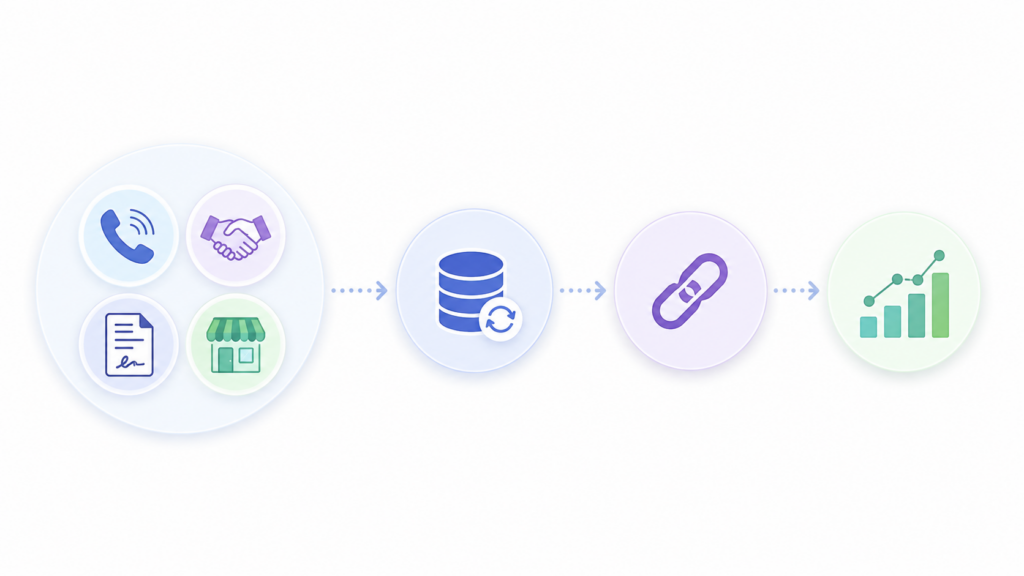
Offline conversions are actions that happen outside the website or ad platform but still represent meaningful business outcomes. These can include qualified leads, sales calls, signed contracts, in-store purchases, product demos completed, proposals sent, or closed-won deals.
To connect offline conversions, the CRM needs to send conversion events back into the attribution system or advertising platforms. For example, when a lead becomes a qualified opportunity, that lifecycle change can be treated as a conversion event. When a deal closes, the revenue value can be pushed back and associated with the original marketing journey.
This is especially useful for businesses with long sales cycles. A campaign may not generate many instant purchases, but it may produce high-quality opportunities weeks or months later. Offline conversion tracking helps marketers avoid underestimating channels that influence revenue later in the funnel.
For a deeper explanation of this concept, Attributy’s guide to offline conversion tracking is a useful supporting resource. The key point is that offline conversions should not sit only in the CRM. They should also inform campaign optimization, reporting, and budget decisions.
CRM Attribution Workflow: From Click to Closed Revenue
A practical CRM attribution workflow usually follows a clear path:
| Step | What Happens | Why It Matters |
|---|---|---|
| Visitor arrives | A user clicks an ad, search result, email, or referral link | Captures the original marketing source |
| Tracking is stored | UTMs, click IDs, landing page, and session data are recorded | Preserves campaign context |
| Lead converts | The visitor submits a form, books a demo, or becomes known | Connects anonymous behavior to a CRM record |
| CRM updates | Sales qualifies the lead and updates lifecycle stages | Adds sales context to marketing data |
| Opportunity is created | Pipeline value and deal stage are added | Connects marketing to revenue potential |
| Deal closes | Closed-won or closed-lost status is recorded | Enables revenue attribution and ROI analysis |
This workflow sounds simple, but many teams struggle because each system uses different definitions. Marketing may define a conversion as a form fill, while sales defines success as a qualified opportunity. Finance may only care about closed revenue. A strong attribution setup aligns these definitions before reporting begins.
That alignment is also why attribution reporting should include both marketing and CRM metrics. Clicks and leads are useful, but they should be viewed alongside pipeline, close rate, deal value, and revenue quality.
Common CRM Attribution Problems to Avoid
The most common mistake is treating the CRM as a perfect source of truth. CRM data is valuable, but it depends on how consistently sales teams update fields, how clearly lifecycle stages are defined, and how well duplicate records are managed. If CRM hygiene is poor, attribution quality will suffer.
Another common issue is overwriting original source data. Many CRMs update lead source fields when a person re-engages, which can erase the first touch or distort the journey. It is better to store first-touch, last-touch, and multi-touch data separately so reporting can answer different questions without forcing one field to do everything.
Duplicate leads and account-level buying committees also create challenges. In B2B, several people from the same company may interact with marketing before one opportunity is created. If attribution only connects one contact to one deal, it may miss the broader account journey. Account-level matching can help, but it requires careful setup.
A final mistake is optimizing only for the lowest-funnel event. Closed revenue is important, but it may take too long to use as the only signal. Teams often need a mix of early, mid-funnel, and revenue-based events so campaigns can be evaluated before the full sales cycle is complete.
How CRM Integration Improves Revenue Attribution
Revenue attribution becomes stronger when CRM data and marketing touchpoints are connected in the same reporting view. Instead of judging campaigns by lead count, teams can evaluate how channels contribute to qualified pipeline, sales velocity, win rate, deal size, and revenue.
This helps answer questions such as:
- Which campaigns generate leads that sales actually accepts?
- Which channels influence high-value opportunities?
- Which content assets support assisted conversions?
- Which campaigns create pipeline but fail to close?
- Which sources produce the best revenue per lead?
The answers may change budget decisions. A campaign with a high cost per lead may still be profitable if it drives large deals. A low-cost channel may need to be reduced if it creates poor-fit leads that never move through the CRM.
This is where dedicated attribution tools can be more useful than platform-level reporting. GA4 and ad platforms provide useful digital data, but they may not fully reflect CRM stages, offline conversions, or multi-touch revenue journeys. For teams comparing options, this guide on GA4 attribution vs dedicated attribution software can help clarify the tradeoffs.
What Role Does Attributy Play in CRM-Based Attribution?
Attributy helps marketers connect campaign activity with lead and revenue outcomes, which is especially valuable when teams need a more holistic online and offline view. Instead of relying only on platform-reported conversions, teams can use attribution data to understand how marketing interactions contribute to CRM outcomes and revenue performance.
This does not remove the need for clean CRM processes. Sales stage definitions, field hygiene, UTM consistency, and lead matching rules still matter. But a stronger attribution setup gives marketing and sales teams a shared view of what is working, where revenue is coming from, and which channels deserve more attention.
For teams evaluating tools, it may also be useful to review how to choose attribution marketing software. And if your team wants to connect CRM data, offline conversions, and revenue attribution in one clearer reporting workflow, you can contact Attributy to discuss your attribution setup.