
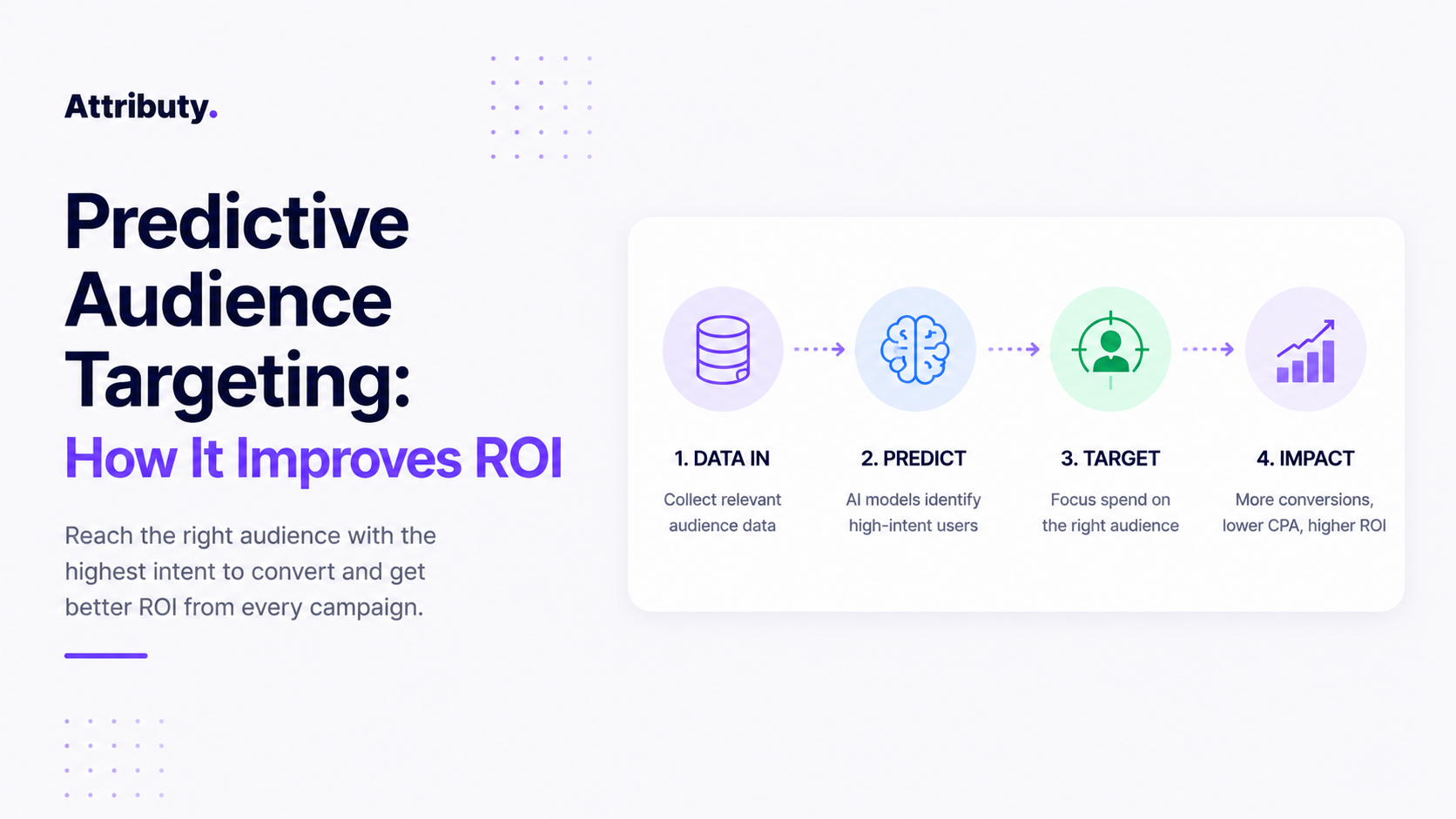
Predictive audience targeting improves ROI by helping marketers focus budget on the users, leads, accounts, or segments most likely to convert. Instead of treating every audience member equally, predictive targeting uses behavioral data, intent signals, historical conversion patterns, and propensity modeling to estimate who is more likely to take a valuable action.
For performance marketers, this matters because ROI rarely improves from more reach alone. It improves when spend is directed toward the right audiences, at the right stage, with the right bid, message, and conversion goal. Predictive audience targeting gives teams a more disciplined way to prioritize budget instead of relying only on broad demographic targeting or last click campaign performance.
What Is Predictive Audience Targeting?
Predictive audience targeting is the practice of using data models to identify and prioritize audiences based on their likelihood to convert. These models can score users, leads, accounts, or segments according to behaviors such as page visits, product interactions, form submissions, email engagement, ad clicks, CRM activity, or past purchases.
In marketing, this often overlaps with conversion propensity modeling. A propensity model estimates how likely someone is to complete a specific action, such as booking a demo, starting a trial, making a purchase, renewing a subscription, or becoming a qualified lead.
Predictive targeting does not guarantee a conversion. It gives marketers a ranked view of probability so they can make better decisions about audience segmentation, bidding optimization, budget allocation, and campaign messaging.
How Predictive Targeting Improves ROI
Predictive targeting improves ROI by reducing wasted spend and increasing the share of budget directed toward higher value opportunities. In many campaigns, a large portion of impressions and clicks come from people who are unlikely to convert. Predictive models help separate low intent activity from signals that suggest real buying interest.
For example, two users may both click a paid search ad. One visits a pricing page, returns through a remarketing campaign, and opens a sales email. The other bounces after viewing one blog post. A predictive model can assign different scores to each user so the marketing team can prioritize spend and follow up where conversion probability is stronger.
Predictive audience targeting works best when different data inputs are connected to clear marketing decisions. The table below shows how common predictive inputs support better ROI decisions.
| Predictive Targeting Input | What It Helps Marketers Identify | ROI Impact |
|---|---|---|
| Intent signals | Users showing active buying or research behavior | Reduces wasted spend on low-intent audiences |
| Propensity modeling | Leads or customers most likely to convert | Improves budget focus and campaign efficiency |
| Segment scoring | Audiences ranked by conversion probability or value | Helps prioritize high-value segments |
| Conversion prediction | Expected likelihood of a future action | Supports smarter bidding and offer decisions |
| Attribution data | Channels and touchpoints influencing outcomes | Connects audience decisions to real performance |
This is where propensity scores in marketing become useful. A score gives marketers a practical way to compare audience members and decide who should receive higher bids, stronger sales follow up, remarketing exposure, or personalized offers.
Better Segment Scoring and Audience Prioritization
Segment scoring is one of the most practical applications of predictive audience targeting. Instead of building static audiences based only on firmographics, demographics, or broad behavior, marketers can rank segments by expected value.
A B2B SaaS team might score segments by company size, product page engagement, CRM stage, content downloads, and trial activity. An ecommerce team might score shoppers based on product views, cart behavior, purchase history, discount sensitivity, and time since last visit. In both cases, the goal is not just to find larger audiences, but to find audiences with stronger conversion prediction signals.
This approach is especially useful when budgets are limited. A smaller, higher probability segment can often produce better ROI than a large audience with weak intent. That does not mean marketers should ignore upper funnel audiences, but it does mean campaign goals should match the probability and value of each segment.
Stronger Bidding Optimization
Predictive audience targeting can also improve bidding optimization. Platforms such as Google Ads, Meta, and LinkedIn already use machine learning to optimize delivery, but advertisers still need to feed those systems with better signals. If the only signal is a low quality conversion event, bidding systems may optimize toward volume instead of business value.
For example, a campaign optimized for all form fills may generate more leads, but not necessarily more qualified pipeline. If predictive scoring identifies which leads are more likely to become revenue, marketers can use those insights to adjust conversion goals, audience exclusions, budget splits, and offline conversion imports.
This is why predictive targeting works best when paired with accurate conversion tracking. Without clean tracking, models may learn from incomplete or misleading data. Poor tracking can cause campaigns to overvalue cheap conversions and undervalue channels that assist higher quality revenue outcomes.
Better Use of Intent Signals
Predictive targeting depends heavily on intent signals. These are behavioral or contextual clues that suggest someone may be moving closer to a conversion. Examples include repeated visits to high intent pages, comparison content engagement, demo requests, cart activity, abandoned checkout behavior, return visits from paid ads, and CRM stage movement.
Not all signals carry the same weight. A pricing page visit may indicate stronger buying intent than a single top of funnel blog visit. A product comparison page may matter more for a software buyer than a general category page. The value of a signal depends on the business model, sales cycle, channel mix, and conversion path.
For a deeper explanation of how these signals work, Attributy’s guide to intent signals in marketing is a useful companion topic. Predictive targeting becomes more reliable when intent signals are clearly defined, consistently tracked, and connected to downstream outcomes.
Why Attribution Still Matters
Predictive audience targeting and attribution should work together. Predictive models estimate future conversion likelihood, while attribution helps explain which touchpoints and channels influenced past outcomes. When both are connected, marketers can make better decisions about where to spend and why certain audiences convert.
For example, a predictive model may show that users who engage with paid search and email are more likely to convert. Attribution can help clarify whether paid search introduced those users, whether email moved them closer to purchase, or whether another channel assisted the conversion. That insight is important because budget decisions should not be based only on the final click.
This is where attribution reporting becomes valuable. Predictive targeting can tell you which audiences deserve attention, while attribution reporting helps validate which channels, campaigns, and touchpoints are contributing to real performance.
Common Mistakes With Predictive Audience Targeting
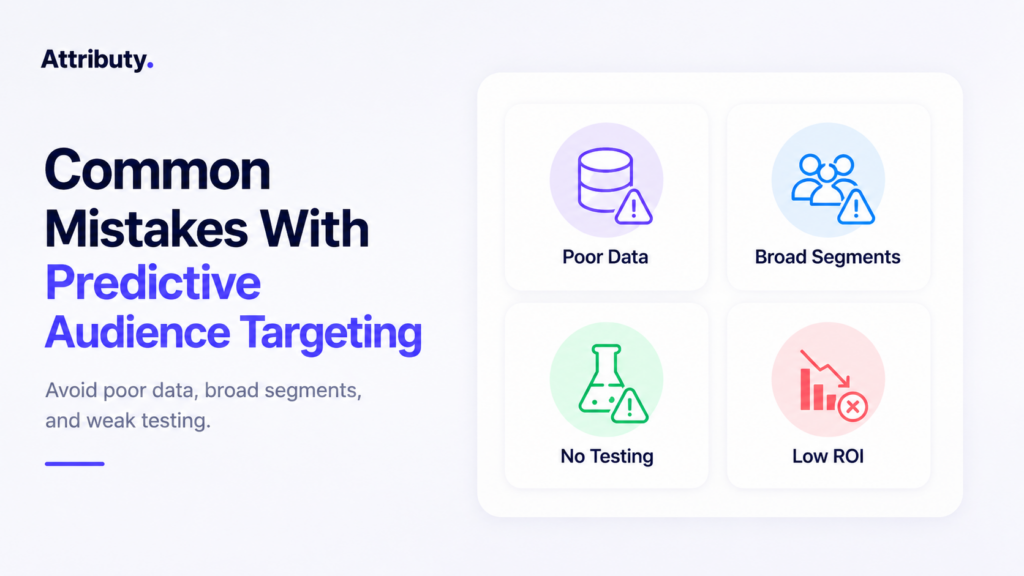
One common mistake is assuming predictive targeting is only a platform setting. In reality, it depends on data quality, event tracking, audience definitions, and the conversion outcomes used to train or guide the model. If the inputs are weak, the output will be weak too.
Another mistake is optimizing only for short term conversions. Some audiences may have lower immediate conversion probability but higher lifetime value, stronger retention, or greater expansion potential. Marketers should avoid excluding valuable long cycle buyers simply because they are not ready to convert today.
A third mistake is treating predictive scores as absolute truth. Scores should guide decisions, not replace judgment. Teams should continue testing creative, messaging, offers, landing pages, and channel mix to understand what actually improves performance.
How to Measure ROI From Predictive Targeting
To measure ROI from predictive audience targeting, marketers need to compare cost, conversion quality, and revenue outcomes before and after predictive targeting is applied. Basic metrics such as click through rate and cost per lead are not enough because they do not show whether the targeting improved business results.
A stronger measurement framework should include cost per qualified conversion, lead to opportunity rate, opportunity to customer rate, revenue per segment, ROAS or marketing ROI, sales cycle length, and customer lifetime value where available. These metrics help teams understand whether predictive targeting is improving the quality of demand, not just increasing campaign activity.
Attributy’s guide to marketing ROI can help teams frame the difference between campaign efficiency and actual return. This distinction matters because a campaign can look efficient at the lead level while still producing weak revenue outcomes.
Where Predictive Targeting Fits in the Marketing Stack
Predictive targeting works best when connected across ad platforms, analytics tools, CRM data, and attribution systems. A model that only sees ad clicks may miss important CRM or revenue signals. A CRM model that ignores marketing touchpoints may fail to explain which campaigns created the highest value demand.
For many teams, the practical goal is not to build a complex custom data science system from day one. It is to improve the quality of audience decisions by connecting conversion data, channel performance, and revenue outcomes. That makes predictive targeting especially useful for teams working on ad spend optimization.
For teams using Attributy, this connection is important because predictive insights become more useful when they are tied back to attribution, channel performance, and revenue reporting. If you want to understand how predictive audience targeting could fit your current measurement setup, you can contact our team to discuss your tracking and reporting needs.
Final Takeaway
Predictive audience targeting improves ROI by helping marketers prioritize audiences with stronger conversion probability, better intent signals, and higher expected value. It supports smarter segment scoring, more efficient bidding optimization, and better budget allocation across campaigns.
The real value comes when predictive targeting is combined with clean conversion tracking, reliable attribution, and revenue based reporting. Predictive models can point marketers toward better opportunities, but measurement is what proves whether those opportunities are actually improving ROI.