20 days ago
3 MIN READ
News, Blog, Case Studies, Onboarding Guides, Research

Attributy
Knowing how to measure marketing ROI is one of the most important skills for any SMB that wants to grow without wasting budget. Marketing ROI shows whether your campaigns are generating enough revenue to justify the money, time, and resources invested in them. The formula looks simple, but the real challenge is making sure your conversion tracking, attribution reporting, marketing attribution, and CRM revenue data are accurate enough to trust.
For many smaller teams, ROI measurement gets messy because data sits in different systems. Ad platforms report clicks and conversions. Analytics tools report website behavior. CRMs report pipeline and revenue. Sales teams may track deals in a way that does not always match campaign reporting. When these systems are disconnected, marketing ROI becomes a rough estimate instead of a reliable performance metric.
This guide gives SMBs a practical tracking checklist for measuring marketing ROI more clearly, with a focus on the data and reporting foundations that matter most.
Marketing ROI measures the return generated from marketing investment. At a basic level, it compares the revenue gained from marketing activity against the cost of producing that revenue.
The common formula is:
Marketing ROI = (Revenue from marketing minus marketing cost) divided by marketing cost
For example, if a campaign generates $30,000 in revenue and costs $10,000 to run, the ROI is 200 percent. That means the campaign generated $2 in net return for every $1 spent.
The formula itself is not the difficult part. The difficult part is knowing which revenue should be attributed to marketing, which costs should be included, and whether the tracking data is complete. If your CRM revenue is not connected to campaigns, or if your attribution model only gives credit to the final click, your ROI number may be technically calculated but strategically misleading.
For a deeper explanation of the metric, Attributy’s guide to what marketing ROI is and what affects it is a useful starting point.
SMBs rarely struggle with ROI because they have no data. More often, they struggle because the data is fragmented. A paid search platform may show strong conversion volume, while the CRM shows that many of those leads never became opportunities. An email campaign may influence several deals, but receive no credit because it was not the final touch before conversion.
This is especially common when marketing and sales use different definitions of success. Marketing may optimize for lead volume, while sales cares about qualified opportunities and closed revenue. If those two views are not connected, ROI reporting can reward campaigns that create activity but not profit.
The most reliable ROI measurement comes from connecting campaign activity to business outcomes. That means tracking conversions properly, using consistent campaign naming, connecting CRM revenue, and choosing a marketing attribution approach that reflects how customers actually buy.
Before tracking campaigns, decide what business outcome matters most. For an ecommerce company, the primary outcome may be completed purchases. For a SaaS company, it may be free trial activations, qualified pipeline, or closed-won revenue. For a service business, it may be booked consultations or paid jobs.
This matters because not every conversion has the same value. A newsletter signup, demo request, and closed deal should not be treated equally in ROI reporting. If your team optimizes every campaign toward the easiest conversion, you may improve lead volume while weakening revenue quality.
A practical approach is to define one primary revenue outcome and a small set of supporting conversions. The primary outcome tells you whether marketing is producing business value. The supporting conversions help you understand how prospects move toward that outcome.
Conversion tracking is the foundation of marketing ROI measurement. It records when users take meaningful actions after interacting with your marketing, such as submitting a form, booking a call, starting a trial, or making a purchase.
Instead of tracking every small interaction as a conversion, SMBs should focus on actions that show commercial intent. Button clicks, scroll depth, and page views can help diagnose user behavior, but they should not be treated as revenue signals on their own.
| Conversion type | When it matters |
| Form submissions | Useful for lead generation campaigns where forms create qualified sales follow-up. |
| Demo or consultation bookings | Stronger than general leads because they show clearer buying intent. |
| Phone calls from campaigns | Important for service businesses, local businesses, and sales-led SMBs. |
| Trial or account signups | Useful for SaaS teams that need to connect acquisition campaigns to product activation. |
| Purchases or closed deals | The strongest ROI input because it connects marketing activity to actual revenue. |
| Offline conversions | Important when sales happen after calls, meetings, or CRM follow-up rather than directly on the website. |
Attributy’s guide to conversion tracking basics explains how this works in marketing reporting. For teams that need a more complete setup, dedicated conversion tracking software for SMB teams can help connect campaign activity, website conversions, and downstream revenue more reliably.
UTM parameters help identify where traffic and conversions come from. They are especially important when measuring ROI across paid search, paid social, email, partnerships, organic campaigns, and retargeting.
The main issue is not whether SMBs use UTMs. Many already do. The issue is whether they use them consistently. If one person uses “paid-social,” another uses “paidsocial,” and another uses “linkedin_ads,” reporting becomes fragmented. Over time, campaign performance is split across duplicate channel names, making ROI harder to analyze.
| UTM field | Example use |
| Source | The platform or publisher, such as Google, LinkedIn, newsletter, or a partner name. |
| Medium | The traffic type, such as cpc, paid_social, email, or referral. |
| Campaign | The specific campaign name, such as product_launch_q2 or smb_demo_offer. |
| Content | The ad creative, audience, placement, or message variation. |
| Term | Mainly used for paid search keyword or query-level tracking. |
A simple naming system can prevent months of reporting problems. Attributy’s resource on UTM governance explains how to build a structure that does not break reporting as campaigns scale.
You cannot measure true marketing ROI if reporting stops at lead volume. Leads only matter if they become pipeline, customers, or revenue. That is why CRM revenue is one of the most important inputs in ROI measurement.
For B2B, SaaS, and service-based SMBs, the CRM should capture where a lead came from, which campaign influenced the lead, how the lead progressed through the pipeline, and how much revenue was eventually closed. This connection lets marketers see which campaigns produce real business outcomes rather than just surface-level conversions.
For example, one campaign may generate 200 leads with only $5,000 in closed revenue. Another may generate 40 leads with $60,000 in closed revenue. If you only look at lead volume, the first campaign looks stronger. If you connect campaigns to CRM revenue, the second campaign is clearly more valuable.
This is where marketing attribution becomes much more useful. Attributy’s guide to marketing attribution with examples explains how attribution connects marketing touchpoints to outcomes across the customer journey.
Marketing attribution determines how credit is assigned across touchpoints. A first-click model gives credit to the first interaction. A last-click model gives credit to the final interaction before conversion. Multi-touch attribution distributes credit across several touchpoints.
For SMBs with short buying journeys, a simple attribution model may be enough. For companies with longer sales cycles, multiple decision-makers, or several paid and organic touchpoints, last-click reporting often undervalues awareness and nurture activity.
The goal is not to find a perfect model. No attribution model captures every influence. The goal is to choose a model that gives your team a useful view of campaign impact and helps guide budget decisions.
Attributy’s comparison of first-click, last-click, and multi-touch attribution models is useful when deciding which model fits your reporting needs. If your customers interact with several channels before converting, multi-touch attribution explained provides a deeper breakdown.
Attribution reporting should help your team decide where to invest, what to improve, and which campaigns to scale. It should not simply display every available metric.
A strong report connects marketing activity to practical business questions. Which channels generate the highest revenue, not just the most leads? Which campaigns influence closed deals? Which touchpoints assist conversions before the final click? Which audiences produce profitable customers?
This is where platform reporting can be limited. Google Ads, Meta, LinkedIn, and other platforms each report performance from their own perspective. That can be useful for channel optimization, but it does not always show the full customer journey. Cross-channel attribution reporting gives SMBs a clearer view of how campaigns work together.
For more detail, see Attributy’s guide to attribution reporting. Teams comparing broader measurement options may also find the guide to cross-channel attribution tools for SMB teams helpful.
Overall marketing ROI is useful for leadership, but it is usually too broad for optimization. SMBs should also compare ROI by channel, campaign, audience, product line, and funnel stage where the data allows.
This prevents broad conclusions that hide important performance differences. Paid social might look unprofitable overall, while one retargeting campaign produces strong ROI. Paid search might look profitable overall, while branded campaigns carry the average and non-brand campaigns underperform.
The purpose of ROI reporting is not to punish every campaign that does not immediately produce revenue. Some campaigns capture existing demand, while others create or nurture demand. The important thing is to understand the role each campaign plays and evaluate it with the right expectations.
Some channels influence buyers without being the final conversion point. Organic content, comparison pages, email nurture, retargeting ads, webinars, and review pages may all support the buyer journey even if they do not receive final-click credit.
Assisted conversions help show when a touchpoint contributed to a conversion without being the last interaction. This is especially important for longer sales cycles, where prospects may discover your brand through one channel, return through another, and convert after several additional touches.
Ignoring assisted conversions can lead SMBs to underfund channels that support demand creation and sales progression. Attributy’s guide to assisted conversions explains how to use this data without overstating influence.
Marketing ROI and ROAS are related, but they are not the same. ROAS compares revenue to ad spend, usually within paid media. Marketing ROI takes a broader view by comparing revenue against total marketing cost.
That broader cost view may include media spend, software, agency fees, creative production, content costs, and team resources. This is why a campaign can have a strong ROAS but weaker ROI once full costs are included.
If your team reports both metrics, label them clearly. ROAS is useful for paid media optimization. Marketing ROI is more useful for budget planning and business-level performance analysis. Attributy’s guide to marketing ROI vs ROAS explains the distinction in more detail.
Not every campaign should be judged on the same timeline. Paid search may show faster revenue signals because it captures active demand. SEO, content, lifecycle marketing, and brand campaigns may take longer to influence pipeline or purchases.
The right reporting window depends on your sales cycle and attribution window. A short window may miss delayed conversions. A very long window may over-credit older touchpoints that had little real influence. The best approach is to align reporting with how long customers usually take to move from first touch to purchase.
For more context, see Attributy’s explanation of click-through and view-through attribution windows.
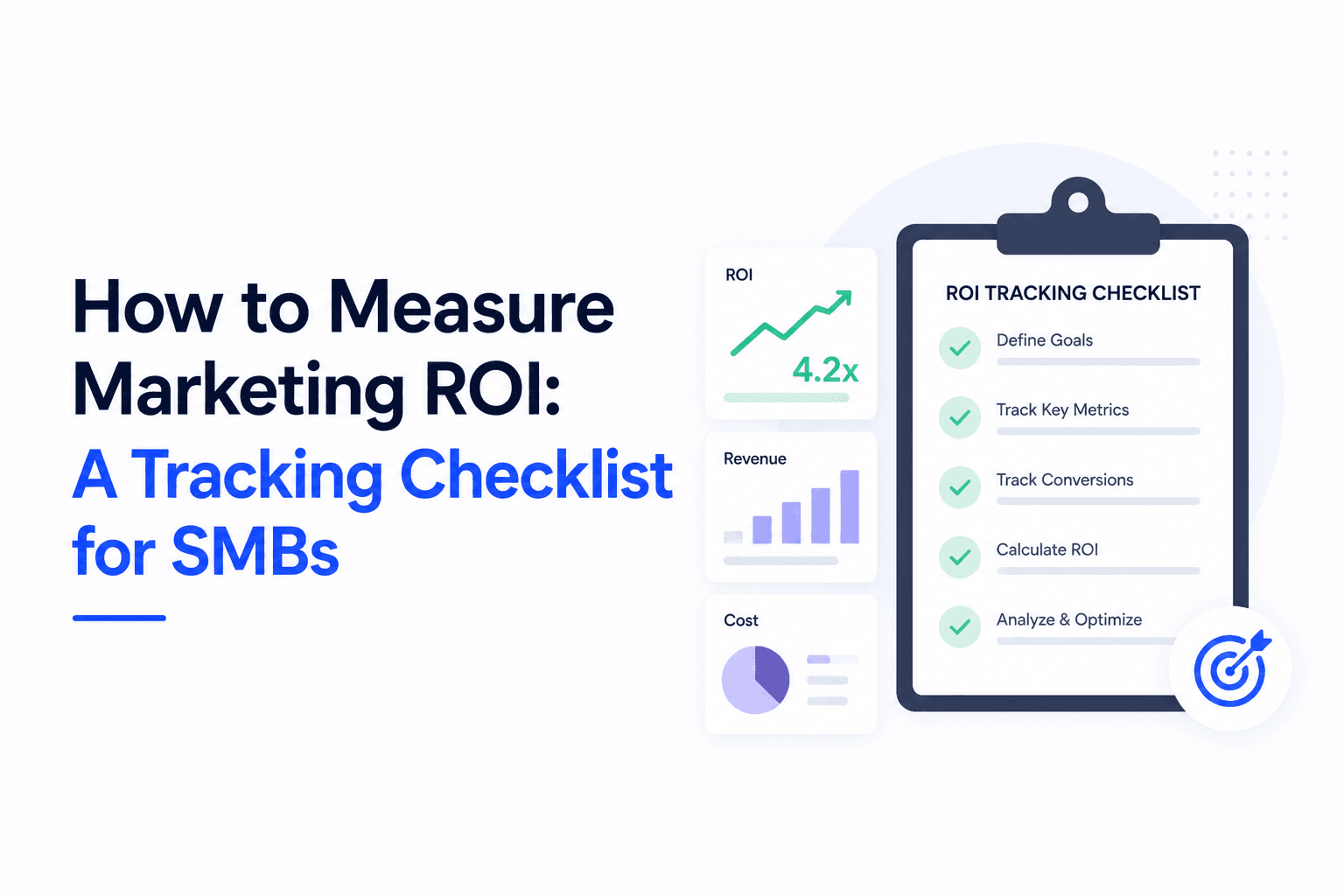
| Step | What to check | Why it matters |
| 1 | Define the revenue outcome | ROI is only useful when everyone agrees what “return” means, such as purchases, closed deals, or qualified pipeline. |
| 2 | Track meaningful conversions | Demo bookings, calls, trials, purchases, and offline conversions are stronger signals than clicks alone. |
| 3 | Use consistent UTM naming | Clean campaign naming prevents fragmented reports and makes channel-level ROI easier to trust. |
| 4 | Connect campaigns to CRM revenue | This shows which campaigns generate actual pipeline and closed revenue, not just leads. |
| 5 | Choose a practical attribution model | The model should reflect the buying journey instead of giving too much credit to one touchpoint. |
| 6 | Build reporting around decisions | Reports should support budget, channel, campaign, and audience decisions. |
| 7 | Compare ROI by channel and campaign | Detailed views show where performance is actually coming from. |
| 8 | Include assisted conversions | Supporting touchpoints may influence revenue even when they are not the final click. |
| 9 | Separate ROI from ROAS | ROAS is usually ad-spend focused, while ROI should account for broader marketing costs. |
| 10 | Use a realistic reporting window | Some campaigns convert quickly, while others need time to influence pipeline and revenue. |
Many SMBs start with spreadsheets, GA4, ad platforms, and CRM reports. That can work at an early stage, but it becomes harder as channels, campaigns, and sales motions become more complex.
Dedicated attribution software can help when your team needs to connect conversion tracking, campaign data, attribution reporting, and CRM revenue in one place. It is especially useful when leadership wants to understand which campaigns drive revenue, which channels deserve more budget, and where tracking gaps are distorting performance.
Attributy helps teams connect marketing activity to revenue outcomes through practical attribution and reporting workflows.
Marketing ROI is not just a finance metric. It is a measurement system that helps SMBs understand which campaigns create revenue, which channels deserve investment, and where tracking gaps may be hiding performance problems.
The most useful ROI reporting comes from clean conversion tracking, consistent campaign naming, connected CRM revenue, and a practical marketing attribution model. When those pieces work together, SMBs can make better growth decisions with less guesswork.
You can also read

43 minutes ago
3 MIN READ
Ad Spend Tracking: What Marketers Need to Measure
Ad spend tracking is the process of monitoring how much money your business spends on advertising and connecting that spend to measurable outcomes such as clicks, leads, conversions, revenue, marketin ...
Attributy
Learn

3 days ago
3 MIN READ
How Click Fraud Affects Attribution and Campaign Reporting
Click fraud attribution refers to the way fraudulent clicks distort how marketing teams assign credit to campaigns, channels, keywords, or ads. When fake clicks from bots, click farms, competitors, or ...
Attributy
Learn

5 days ago
3 MIN READ
How Do You Reallocate Marketing Budget Across Channels?
You reallocate marketing budget by moving spend from lower-performing or saturated channels toward channels with stronger performance signals, better marginal returns, and more room to scale. The goal ...
Attributy
Learn

7 days ago
3 MIN READ
What Is Unified Marketing Measurement?
Unified marketing measurement is a marketing measurement framework that combines different data sources and methodologies to understand how marketing affects performance across channels, campaigns, an ...
Attributy
Learn

10 days ago
3 MIN READ
Propensity Scores in Marketing: What They Measure and How Teams Use Them
Propensity scores in marketing are numerical ratings that estimate how likely a person, account, or audience segment is to take a specific action. That action might be making a purchase, requesting a ...
Attributy
Learn
12 days ago
3 MIN READ
Marketing Mix Modeling vs Attribution: When Each Works for SMBs
Marketing mix modeling vs attribution is a common comparison for SMB marketing teams trying to understand what actually drives revenue. Both approaches help measure marketing performance, but they ans ...
Attributy
Blog

13 days ago
3 MIN READ
UTM Parameters: Definition and Best Practices
UTM parameters are short pieces of tracking code added to the end of a URL to identify where website traffic comes from and how a campaign performs. Marketers use UTM parameters, also called UTM tags, ...
Attributy
Learn

17 days ago
3 MIN READ
Marketing Budget Allocation: A Practical Framework for SMB Growth
Marketing budget allocation is the process of deciding how much money to invest across channels, campaigns, audiences, and marketing activities based on business goals, expected returns, and available ...
Attributy
Blog

19 days ago
3 MIN READ
Ad Spend Optimization: A Practical Guide for B2B & SMB Marketers
Ad spend optimization is the process of improving how marketing budget is allocated, measured, and adjusted so each dollar has a better chance of contributing to revenue, pipeline, or qualified demand ...
Attributy
Blog
